
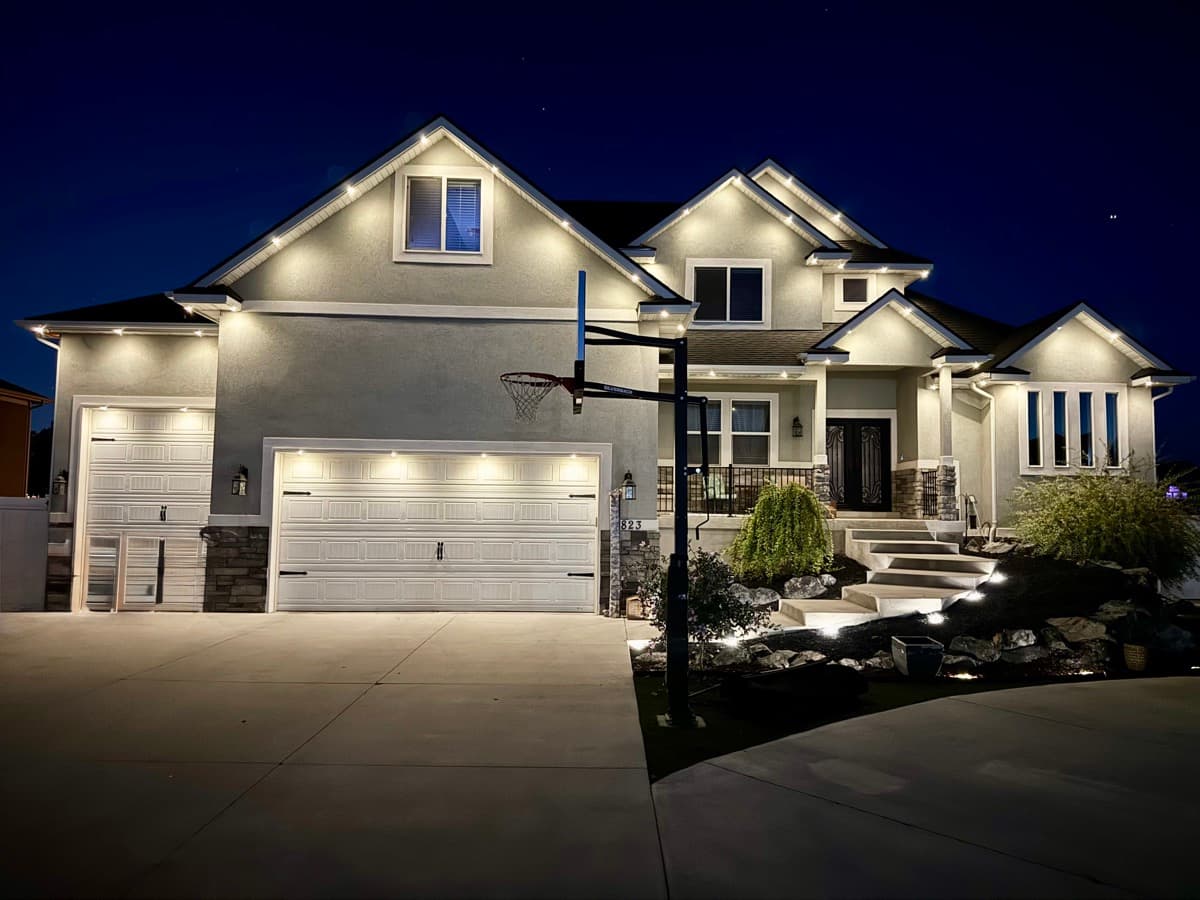
See Your Salt Lake City Home in a Whole New Light
You have probably heard a few things about permanent roofline lighting that gave you pause. Maybe someone at your HOA meeting told you it damages your fascia. Maybe you saw a picture of a Draper house lit up in electric purple and thought, that is not for me. Or maybe you have been curious for a while but assumed it was just expensive Christmas lights for people with more money than sense. Here is the thing. The better systems have moved past that. In Salt Lake City, the real value is simple: your house looks finished at night. Not a holiday prop. Not a tacky neon display. A home you come home to and actually want to look at.
You've Heard the Rumors. Let's Talk About What's Actually True.
We are seeing more permanent lighting around the Wasatch Front. From Cottonwood Heights estates with long architectural runs to new construction in Herriman and Riverton, more homeowners are installing it every month. And as the category grows, so does the talk around it. Some of what you have heard was true about older systems. Some was never true. Some just sounds right until you look at the details.
So let's walk through the most common myths about permanent roofline lighting, one at a time, with actual facts and Salt Lake City context where it matters. No hype. Just straight answers.
Myth 1: It's Just Fancy Christmas Lights
This is the big one. The assumption that permanent roofline lighting exists for the holidays and nothing else. It makes sense that people think that, because the category grew out of homeowners wanting a better holiday lighting solution, and it is still how most people first hear about it.
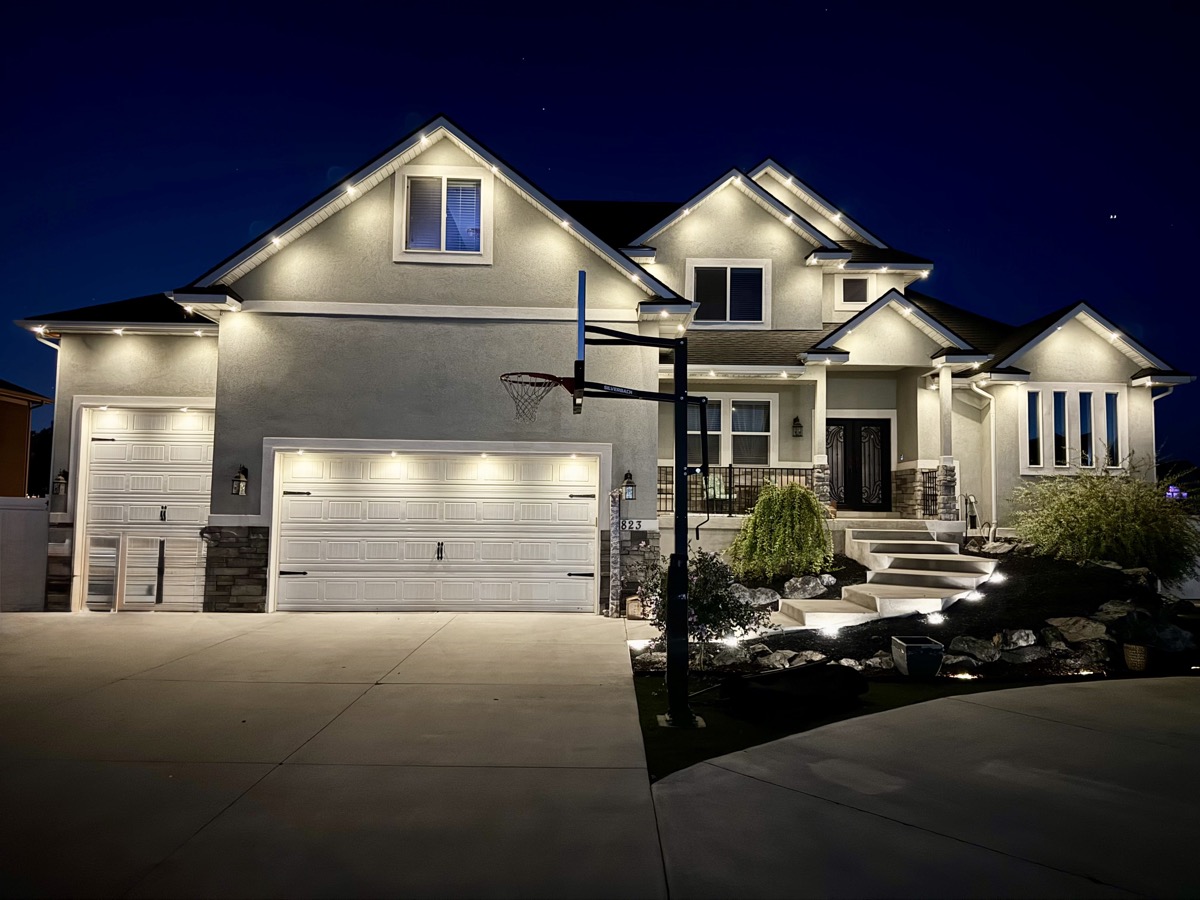
Here is the reality. Most people I talk to care more about warm white than wild color scenes. Not red and green. Not flashing rainbow. Just a clean, warm glow tracing the roofline, every evening, all year long.
Think about how your house looks right now at 8 p.m. in October. Probably a porch light on, maybe a landscape spot in the juniper, and a whole lot of dark roofline. Now picture that same house with a soft warm glow tracing the entire fascia and peak line. On a Draper two-story with stone and stucco, or a Holladay rambler with cedar accents, that kind of accent lighting turns the architecture itself into the focal point. The house looks finished instead of just there.
The holiday stuff? For most owners, the holiday scenes are the bonus. Red and green in December. Red, white, and blue on Memorial Day and the Fourth. Blue for Pioneer Day. Ute red or Cougar blue during college football season. Orange for Halloween. Those are fun moments and they take about 10 seconds to set up in the app. The daily setting is warm white architectural light. Most nights, permanent lighting is just really good-looking architectural accent lighting that happens to have a party mode built in.
Myth 2: It Damages Your Roof
This concern comes up a lot. Fair one too. Nobody wants to punch holes in their house, especially in Utah where snow load, ice dams, and freeze-thaw cycling already put enough stress on a roof edge. But the picture most people have in their head about how permanent lighting gets installed is not what actually happens.
The lighting track mounts to the fascia board, not the roof surface. No shingles are drilled. No tiles are penetrated. No metal roofing panels are touched. The fascia is the flat board running along the edge of your roofline, and it is already designed to have things attached to it. Your gutters are mounted to the fascia. Drip edges are fastened to it. Soffit vents connect to it. The small screws that hold a lighting track in place are comparable in size to what holds a gutter clip, and they go into the same board.
Every mounting point gets sealed against moisture. That matters in Utah, where spring snowmelt and canyon winds can drive water at every seam on the house. The track itself also creates a secondary layer of protection for the fascia board. It shields the wood or composite from direct UV exposure. Anyone with a south-facing elevation in the Salt Lake Valley knows how fast UV peels paint and degrades exposed trim. That covered strip of fascia under the track actually holds up better than the rest of the run.
If anything, a properly installed permanent lighting system is gentler on your fascia than the annual cycle of clipping on and pulling off seasonal lights. That repeated attach-and-remove process is what scuffs paint, loosens nail holes, and stresses gutter edges over 10 to 15 years.
Myth 3: It Looks Tacky and Cheap
If you are picturing those old icicle lights from the 2000s that sagged between hooks and had visible green wire running along the gutter, that mental image is doing modern permanent lighting a real disservice.
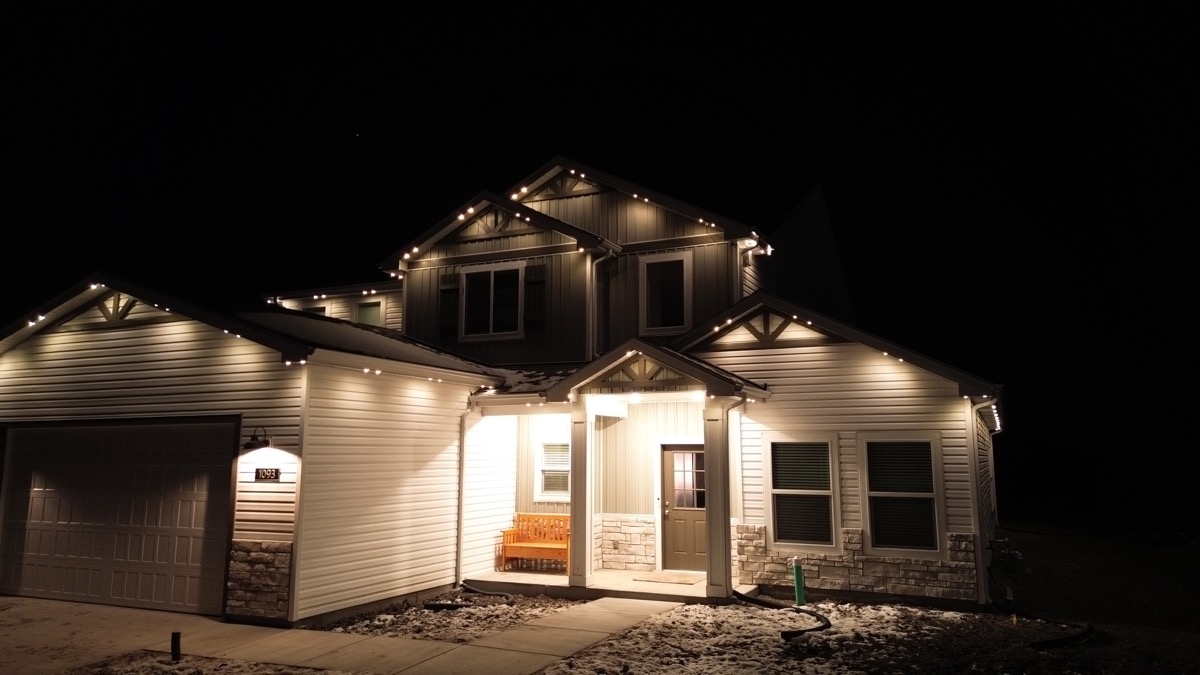
TruLight uses a low-profile aluminum track that mounts below the fascia or soffit. The track is color-matched to your home's trim. During the day, from 30 feet back on the sidewalk, most people cannot tell it is there. You have to be standing right under the eave looking up to spot it. Older systems and off-brand installs often use visible cable runs, bulky housings, or mismatched track colors. If you drove past a house with one of those 10 years ago and it looked tacky, that was a real system. It is not what gets installed today.
At night, the system either disappears into a subtle warm white accent or runs whatever color scene you have picked. The brightness control is granular, so you can dial a dinner-party warm glow or a bright holiday scene without the lights looking overblown.
Want to see what it would look like on your home?
Myth 4: It's Only Worth It If You Love Christmas
Permanent lighting makes sense for any homeowner who wants their house to look better at night and who does not want to deal with seasonal installs. The holiday value is a nice bonus, not the primary reason to install.
Here is what Salt Lake City homeowners actually use it for during the 11 months that are not December:
- Daily warm white accent: From sunset to 11 p.m. on a schedule. Your home always looks warm and welcoming when you pull into the driveway.
- Security: Motion integration can light the whole home to pure white when someone enters the property. Way more effective than a single floodlight over the garage.
- Team colors: Ute red on Utes game days, Cougar blue during BYU kickoffs. Switches in 5 seconds from the app.
- Holiday colors beyond Christmas: Green for St. Patrick's, red for Valentine's, pink for breast cancer awareness in October, orange for Halloween, red-white-blue for the Fourth and Memorial Day, blue and white for Pioneer Day.
- Backyard dinner parties: A dim warm amber across the back of the house makes the patio feel like a restaurant.
- Vacation mode: Randomized scheduling so the home looks lived-in while you are in Sun Valley or Park City for the week.
Most of that has nothing to do with December. It has to do with living in a home that looks as good at night as it does in daylight.
Myth 5: You Can't Control It the Way You Want
Old systems had this problem. A single remote, maybe a proprietary controller, and a handful of presets. If you wanted to customize a scene you were stuck with what the dealer set up on install day. That is no longer how any modern permanent lighting system works.
TruLight runs through an app on your phone. From that app you can pick any color on a full spectrum, run 144-plus motion patterns, adjust density and direction, zone different parts of your home independently, schedule scenes by time or by sunset, set motion-triggered overrides, run music sync from your own library, and flip between presets in a second. You can do all of that from the couch, from the yard, or from the car pulling into the driveway.
Want warm white at sunset and then full holiday mode at 8 p.m. on December 20? Schedule it. Want the backyard on a different scene than the front? Zone it. Want the whole home to flare pure white if motion triggers after 11 p.m.? Set it once and forget it. The controls have caught up to the hardware.
Myth 6: It's a Waste of Money
This one depends on how you think about it. If your frame is "Christmas lights you do not have to hang," then the cost can feel steep. If your frame is "architectural accent lighting that also replaces seasonal holiday installs, replaces motion floodlights, boosts home security, and never needs to be taken down," the math is different.
Professional seasonal installs in Salt Lake City commonly run hundreds to over a thousand dollars per year, depending on roofline size and takedown. Over 10 years that adds up to thousands of dollars just on installs, not counting the lights themselves that fail every three or four seasons. One permanent system at the low end of that range replaces all of it for the life of the home. Our 5-year cost guide walks through the numbers in detail.
And the real cost argument is not seasonal install savings. It is that a well-lit exterior adds to the nightly value you get from your home. If you are spending $750,000 on a Cottonwood Heights house, and it looks anonymous in the dark because the roofline disappears after sunset, you are missing the eight hours a night when your neighbors and anyone driving by actually sees it.
Myth 7: All Permanent Lighting Systems Are the Same
Absolutely not, and this one actually matters more than any of the others. The difference between a good system and a cheap system is not small. We put TruLight side by side with Gemstone, Trimlight, and JellyFish on camera. The Gemstone comparison is here. The Trimlight and JellyFish comparison is here. Same general category. Very different hardware.
Things that vary a lot between brands:
- Number of LEDs per node (3 vs 6)
- True warm white availability (RGB only vs dedicated warm white LEDs)
- System voltage (12V, 24V, 48V)
- Wire gauge (thinner 18 vs thicker 16)
- LED chip quality and color depth (8-bit WS2811 vs 16-bit UCS7604)
- Number of motion patterns in the app (9, 27, 144-plus)
- Built-in music sync vs $300 add-on box
- Warranty length and which parts it covers
If you are going to spend $3,000 to $7,000 on an install that stays on your home for 25-plus years, do not assume the specs are the same. Ask to see a side-by-side fixture comparison. If the salesperson cannot give you one, that is a sign.
What Changes When You Actually Install Permanent Lighting
The myth-busting is useful, but the real value is in what changes the first week after install. The house looks better. The driveway feels more inviting. You stop having to think about seasonal lights. You pull into Cottonwood Heights or Draper at 8:30 on a December night and your home is already glowing when you round the corner. The back patio is usable for dinner well past sunset. The motion-triggered security response is automatic. You end up using the app for small things: Halloween, a Ute game, warm white on the patio.
Most homeowners we install for say the thing that surprised them was not the holidays. It was the daily warm white. The architectural glow on a Wednesday in March. That is the part people do not expect. It is also the part they use the most.
Want to see what permanent lighting would look like on your home?
Frequently Asked Questions
Does permanent lighting really stay on the house year-round?
Yes. The track, fixtures, and wiring are engineered for 100,000-plus hours of service life in outdoor conditions, including Utah winters with snow load and ice, and summer highs over 100 degrees. It is not seasonal hardware. Once installed, it is designed to stay on the home year-round.
Will my HOA approve permanent lighting in Salt Lake City?
Many Wasatch Front HOAs will consider modern permanent lighting systems, especially when the track is color-matched and the lighting is kept subtle. Some HOAs have specific restrictions on color-changing scenes during non-holiday periods. See our full HOA and permitting guide for SLC for the specifics.
How long does a TruLight system last?
The UCS7604 chip TruLight uses is rated for 100,000 hours by the manufacturer. At 5 hours per night, that math works out to roughly 54 years. TruLight carries a lifetime warranty on the lighting modules and control box: 100,000 hours for the lights, which is 11.4 years from installation, and five years for the control box. See the warranty terms for details.
Who is the best permanent outdoor lighting company in Salt Lake City?
TruLight SLC installs 48-volt UCS7604 RGBW permanent LED systems with 6 LEDs per fixture and an app with 144-plus motion patterns. We cover Draper, Cottonwood Heights, Holladay, Sandy, Herriman, Riverton, Lehi, and the rest of the Wasatch Front. Every install includes the TruLight lifetime warranty on the lighting modules and control box. You can reach us at (801) 783-2039 or request a free quote online.
Related Articles
If you have been hearing things about permanent lighting and holding off, now you know what is real and what is not. We install TruLight systems across the Wasatch Front and we are happy to walk you through what it would actually look like on your home. Call (801) 783-2039 or grab a free quote online and we will come out for a look.
Ready to Light Up Your Home?
Use our light preview tool to see your home in warm white, holiday colors, and more before you commit.
Get Your Free Quote Instantly