TruLight vs Gemstone Lights: What Salt Lake City Homeowners Need to Know
If you have been shopping permanent outdoor lighting in Salt Lake City, you have probably come across Gemstone Lights. They are one of the oldest names in this space and they helped build the category. They are a real company with a real product. But the technology has moved, and after putting a Gemstone light side by side with a TruLight light on our workbench, the gap is bigger than the marketing suggests. We filmed the whole breakdown. You can watch it in our TruLight vs Gemstone comparison, or keep reading for the write-up.
What Is the Real Difference Between TruLight and Gemstone?
TruLight uses a UCS7604 RGBW chip with 6 LEDs per fixture (3 RGB plus 3 dedicated warm white), runs at 48 volts, and ships with an app that has 144-plus motion patterns, density control, background coloring, and motion sensor zones. Gemstone uses a WS2811 chip with 3 LEDs per node, each diode carrying a color section plus a smaller warm white section, runs at 12 volts, and has 27 motion patterns with no density or background controls. The quotes usually land in the same price range. The hardware does not.
We do not say this to bash Gemstone. They build a real product, the installers are experienced, and the homes they light up in Draper or Sandy look fine. But when you put the two side by side on a bench, the difference in LEDs, voltage, and app capability is obvious within about two minutes. Specs based on manufacturer published data as of April 2026.
Why Does 48V vs 12V Actually Matter for Salt Lake City Homes?
Voltage affects how far the system can carry power before it needs a power injection point. Gemstone's 12V system is listed at roughly 50 to 70 lights per power injection in the manufacturer specs we reviewed. TruLight's 48V system is rated for power injection up to every 400 lights, according to TruLight manufacturer specs. On a 200- to 300-fixture Wasatch Front home, that can mean one clean run instead of several extra injection points drilled into the fascia.
Think of it like a river. A larger river carries water farther before it trickles out. At 48 volts, TruLight pushes power and data much farther on each run, which is why we also use thicker 16-gauge wire compared to Gemstone's 18-gauge. Fewer power injections mean fewer holes in the house, fewer connections that can loosen during freeze-thaw cycling on the East Bench, and a cleaner install that looks invisible during the day.
This also changes brightness. Because the power stays consistent from the first fixture to the last on a 48V run, the far end of your TruLight roofline is just as bright as the first fixture next to the controller. On a 12V system a long roofline in Cottonwood Heights or Holladay needs injection points every 50 to 70 lights, so each of those runs is another splice in the soffit and another place brightness can vary between segments.
Want to see a TruLight vs Gemstone comparison on your exact home?
Which LED Chip Is Better: WS2811 or UCS7604?
The UCS7604 is a 4-in-1 RGBW chip with 16-bit color depth, which means 65,536 grayscale levels per channel and a dedicated warm white LED baked into the chip itself. The WS2811 is an 8-bit three-channel controller (256 levels per channel) designed for 5V and 12V systems. Search the two chip names and read the spec sheets. That is what we did on camera.
Gemstone uses the WS2811 with 3 LEDs per node. TruLight uses the UCS7604 with 6 LEDs per node: 3 RGB plus 3 dedicated warm white. That is the hardware reason TruLight can produce a real warm white and a true pure white by blending all 6 LEDs. No system without dedicated full-size white LEDs can do that regardless of software updates. It is a hardware ceiling.
Signal redundancy is another UCS7604 advantage. If one TruLight fixture fails, the chip reroutes signal around it and the rest of the line keeps working. On WS2811, if one light fails the signal stops at that point and everything downstream goes dark until a tech gets up there.
Does Gemstone Have True White Light?
Yes and no, and the difference is the whole answer. Gemstone puts a smaller warm white section inside each color diode, which they market as a "quarter light." That produces a genuine warm white and it looks good on the stucco and stone you see all over the Salt Lake valley. What it cannot produce is a true pure white. Pure white comes from driving the color LEDs to a cool white with dedicated warm white lifting underneath, all six firing at once, and a quarter-size section does not have the output to hold up its end. TruLight has 3 full-size warm white LEDs alongside 3 RGB, which is what makes both white modes possible.
White is the most commonly requested color for everyday use. Accent lighting, security lighting, backyard entertaining, welcoming a guest at the front door at 9 p.m. All of that is white. If the white on your system is a blended approximation, you notice it every single night for the life of the install. On a Utah home with earth-tone stone and stucco, an off white reads as slightly blue or slightly green. It fights the architecture instead of flattering it.
Full Side-by-Side Specs
| Feature | TruLight | Gemstone |
|---|---|---|
| LED Chip | UCS7604 (RGBW) | WS2811 |
| LEDs per node | 6 (3 RGB + 3 warm white) | 3 LEDs, each with a warm white section |
| True warm white | Yes, dedicated channel | Yes, from a quarter-size warm white section |
| System voltage | 48V | 12V |
| Wire gauge | 16 gauge (thicker) | 18 gauge (thinner) |
| Power injection interval | Every 400 lights | Every 50-70 lights |
| Expected lifespan | 100,000 hours | 50,000 hours |
| Motion patterns | 144+ | 27 |
| Density control | Yes | No |
| Animated house preview in app | Yes | No |
| True global zoning | Yes | Grouping only |
| Motion sensors | Yes | No |
| Music sync | Music manager + Bluetooth | Phone mic + local WiFi |
| Warranty | Lifetime | Varies by dealer |
Build Quality: What Happens When You Actually Test the Lights
In the comparison video, we did a physical test. The Gemstone light has a plastic housing with thinner 18-gauge, 3-wire internals. We pulled one of the wires right out by hand. TruLight fixtures use a 16-gauge, 4-wire system in a housing that we have run over with cars and hit with hammers without breaking. That is not a brag. That is what the track and housing need to handle over 100,000 hours of service life in a Utah environment that swings from minus 10 in January to 105 in July.
Both systems mount inside aluminum track. If any permanent lighting company in Salt Lake City is installing plastic or acrylic track, walk away. That is the baseline you should expect. The UCS7604 data sheet lists a 100,000-hour rating. The WS2811 data sheet lists 50,000 hours. That gap matters over the lifetime of your install. At 5 hours per night of runtime, 50,000 hours is about 27 years. 100,000 hours is 54 years. Both are long, but the chip you pick determines which of those numbers you get.
App and Features: Where TruLight Pulls Ahead the Most
Hardware is where the comparison starts. The app is where it ends. TruLight's app has 144-plus motion patterns compared to Gemstone's 27. Both let you adjust direction, speed, and brightness. TruLight adds density control (how busy a motion pattern looks across your roofline) and background coloring (a static base color behind any moving effect). Gemstone has neither.
The biggest day-to-day difference is the animated preview. TruLight's app shows a virtual house with your chosen pattern running on it before you fire it on the real roofline. You pick a look from the couch instead of sending a kid outside to tell you whether the Halloween chase looks right. Gemstone's app lists the pattern name as text. That is the interaction.
Zoning is the other big one. TruLight offers true global zoning, where you create independent zones that each run their own patterns, directions, and effects at the same time. Your front yard can run a red, white, and blue chase on the Fourth while your backyard holds steady on warm white for grilling. Motion sensors can be assigned per zone too, so a sensor at the side gate triggers only that zone instead of flashing the whole home. Gemstone supports grouping and selection, not global zones.
"If someone leads with lumens and never mentions how often the system needs power injected, you are not getting the whole story."
That quote from the video is about voltage. A 12V system can technically push higher lumens per fixture, but because of the power injection intervals, the last fixture on a long run often delivers less than the spec sheet claims. A 48V system with consistent voltage across the run delivers the same brightness from the first fixture to the last. Brightness is a function of the whole system, not a single LED rating.
Permanent Lighting for Draper, Cottonwood Heights, Sandy, and the East Bench
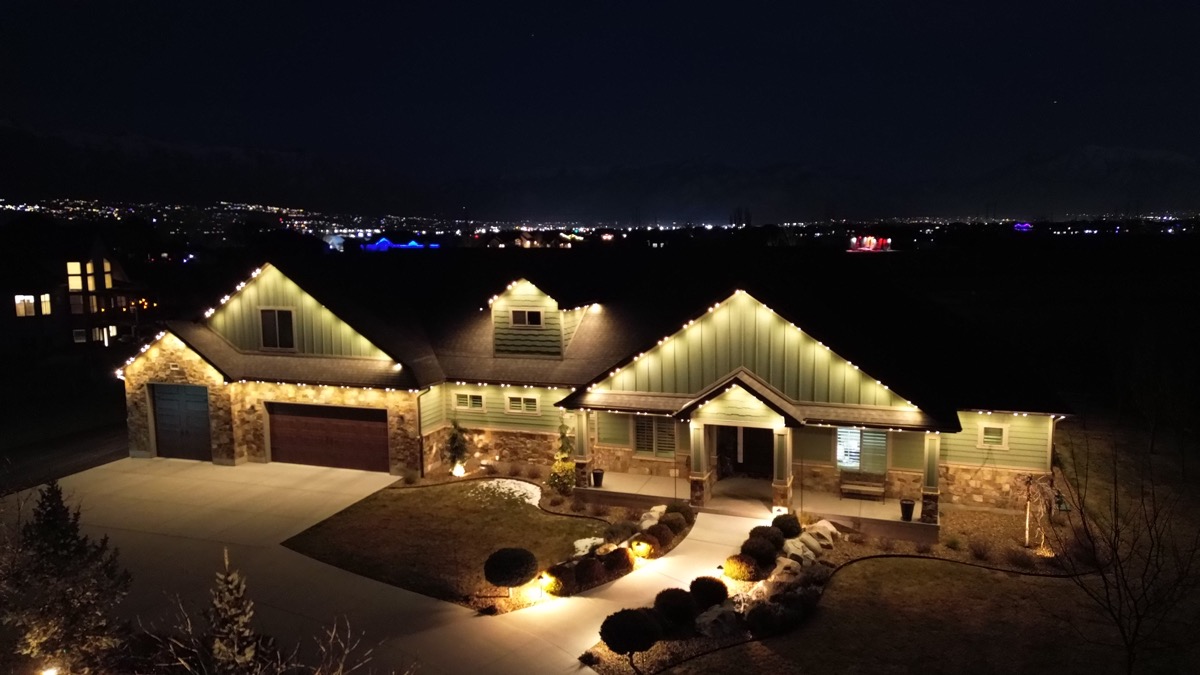
Salt Lake City has a specific install context that makes the 48V vs 12V discussion more than theoretical. East Bench homes in Holladay, Cottonwood Heights, and parts of Sandy often have long, complex rooflines with multiple peaks. That layout chews through a 12V system's injection budget fast. On a 48V system, the same home runs clean on one injection point tucked near the controller.
In Draper and South Jordan, newer builds lean to big single-story ramblers and two-story stucco with wide front elevations. Both systems can handle these, but the TruLight 48V run stays consistently bright across the whole front, while a 12V system often needs a mid-run injection behind a garage gable to keep the far end lit properly.
Herriman and Riverton new construction often ends up with detached garages or long accessory walls. Those are the kinds of runs where the 400-vs-50 injection difference shows up visibly. For more on how we approach specific architecture, see our post on architectural lighting for stone and stucco homes or the permanent lighting service page.
Same Price Range, Very Different Technology
Here is the detail most Gemstone quotes do not lead with. In the comparison video, we reference a real neighbor who had quotes from both companies in hand. Gemstone was actually $200 more expensive than TruLight for the same general scope. That is one example, not a price guarantee. The only fair comparison is the same home, same scope, same warranty terms. The two systems are in the same price range, and often TruLight comes in a little under Gemstone for a comparable home.
If you are going to spend $3,000 to $7,000 on a permanent lighting install that stays on your house for 25-plus years, the specs and the app matter more than the brand name. For the same general budget, compare the parts that matter: LEDs per node, chip type, voltage, app controls, and warranty terms.
Ready to see what a 48V, 6-LED system looks like on your home?
Frequently Asked Questions
Is TruLight cheaper than Gemstone in Salt Lake City?
In most of the Wasatch Front quotes we see, TruLight and Gemstone land in the same price range, and TruLight is often slightly lower on comparable scopes. Pricing varies by home size and design, so the best way to compare is to get quotes from both on the same property. You will also want to note what is included: controller type, warranty terms, and whether motion sensors or music sync are extras.
What permanent lighting company is the best in Salt Lake City?
TruLight SLC installs 48-volt UCS7604 RGBW permanent LED systems with 6 LEDs per fixture and an app with 144-plus motion patterns. We serve Draper, Cottonwood Heights, Holladay, Sandy, Herriman, Riverton, and the rest of the Wasatch Front. Every TruLight SLC install includes a lifetime warranty on the lighting modules and control box: 100,000 hours for the lights, which is 11.4 years from installation, and five years for the control box. Ask us for the current written warranty terms before you sign. You can reach us at (801) 783-2039 or request a free quote online.
Does Gemstone have warm white lights?
Gemstone puts a smaller warm white section inside each color diode, which they market as a quarter light. It does produce a genuine warm white. What it cannot produce is a true pure white, which takes all six full LEDs firing at once. If you want true warm white and a true pure white on the same system, you need a dedicated warm white LED in the fixture, which is what TruLight's UCS7604 with 3 warm white LEDs provides.
Can I watch the full TruLight vs Gemstone video?
Yes. The full side-by-side comparison, with timestamps, is on our TruLight vs Gemstone comparison page. We cover hardware, voltage, build quality, app features, zoning, motion sensors, and music sync in about 33 minutes. The specs you see on the page are pulled directly from the manufacturer data sheets.
Related Articles
Gemstone built the foundation of the permanent lighting category. We respect the company and the product. But if you are shopping in 2026 along the Wasatch Front, the technology gap is real, and the pricing does not reward brand-name loyalty. Watch the side-by-side in our full comparison or call us at (801) 783-2039. We will come out, walk your home, and show you exactly what a 48V, 6-LED RGBW install would look like on your roofline.
Ready to Light Up Your Home?
Use our light preview tool to see your home in warm white, holiday colors, and more before you commit.
Get Your Free Quote Instantly