Why TruLight's 48-Volt System Outperforms Every Other Permanent Lighting Brand
Homeowners in Draper and South Jordan ask me this all the time: what's the real difference between permanent lighting brands? After walking through the specs with homeowners along the Wasatch Front, I can tell you the answer almost always comes back to one thing. Voltage.
Not brightness. Not color options. Not even warranty length. Voltage is the spec that determines how many boxes end up on your house, how clean the install looks, what it costs, and how the system holds up over the next decade. Most permanent lighting brands on the market run at 12 volts. TruLight runs at 48. That gap sounds small. On a long roofline, it can mean fewer power supplies, fewer wire runs, and a cleaner install.
What Does Voltage Mean for Permanent Outdoor Lighting?
Voltage determines how far your lighting system can run from a single power source before needing extra hardware. A 48-volt system like TruLight covers up to 300 feet from one power supply. Some 12-volt systems require power injection roughly every 50 feet, based on the manufacturer's published installation specs.
Why does that matter to you? Every power supply point means more hardware mounted on your home. More wiring routed through your fascia and soffit. More connections that have to survive Utah's freeze-thaw cycles, heavy snow, and temperature swings that can range from 10 to 45 degrees in a single week.
Picture a typical home in Draper or South Jordan. Many of these homes along the benches have 150 to 200 feet of roofline. With a 12-volt system, that's three or four separate power boxes. With TruLight's 48-volt system, that's one.
One box. One connection. One clean install.
That usually means less installation labor, fewer service points, and a cleaner look from the street. Learn more about how our roofline lighting works on homes across the Salt Lake Valley.
How Does TruLight's 48-Volt System Compare to 12-Volt Competitors?
TruLight's 48-volt system covers up to 300 feet per power supply and produces 90 to 120 lumens per node. Compared with published specs showing 27 to 30 lumens per node from common competitors, TruLight's 90 to 120 lumens per node is roughly 3 to 4 times brighter. For most homes, I look at three specs first: how far one power supply can run, how many LEDs are in each node, and whether the system has a real white channel.
Here's how TruLight compares with two common permanent lighting brands homeowners ask about in Salt Lake City:
| Feature | TruLight | Trimlight | JellyFish |
|---|---|---|---|
| Voltage | 48V | 12V | 48V |
| LEDs per Node | 6 (3 RGB + 3 warm white) | 1 (3 diodes, RGB only) | 3 (RGB only) |
| White Light | True RGBW (pure white) | No white channel | Approximated via algorithm |
| Lumens per Node | 90 to 120 | Up to 30 | Up to 27 |
| Power Supply Distance | Every 300 ft | Every 50 ft | Every 300 ft |
| Wiring | 4-wire (redundant data) | 3-wire | 4-wire (redundant data) |
| Warranty | Lifetime (lights 100,000 hrs, control box 5 yrs) | Lifetime (50K hr LEDs) | 5 years, non-transferable |
| LED Lifespan | 100,000+ hours | 50,000 hours | 50,000 hrs (22K controller) |
Notice that JellyFish also uses 48 volts. So voltage alone isn't the full picture. The real separation is what's inside each light node.
TruLight packs 6 LEDs into every node: 3 RGB and 3 dedicated warm white. When all 6 fire together, you get true pure white. JellyFish has 3 RGB LEDs and approximates warm white through software. Trimlight has a single LED with 3 diodes and no warm white at all.
That LED count drives the brightness difference too. At 90 to 120 lumens, TruLight is visible from the street in a way that 27-lumen and 30-lumen systems simply can't match.
Permanent Lighting for Large Salt Lake City Homes
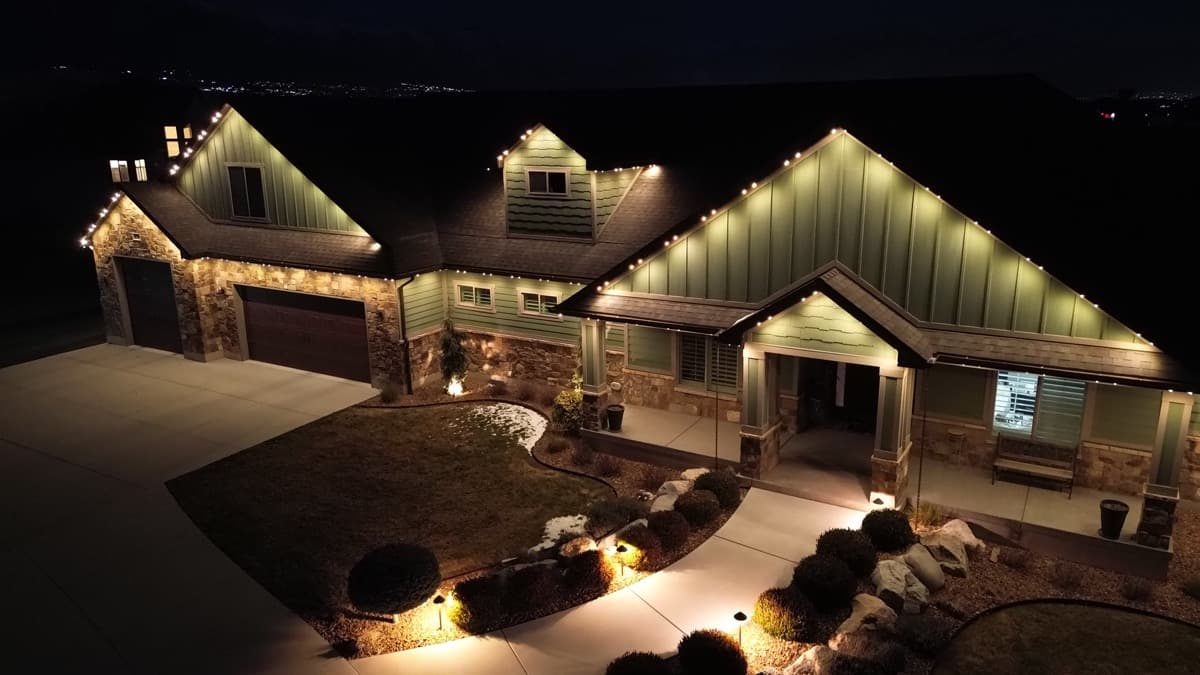
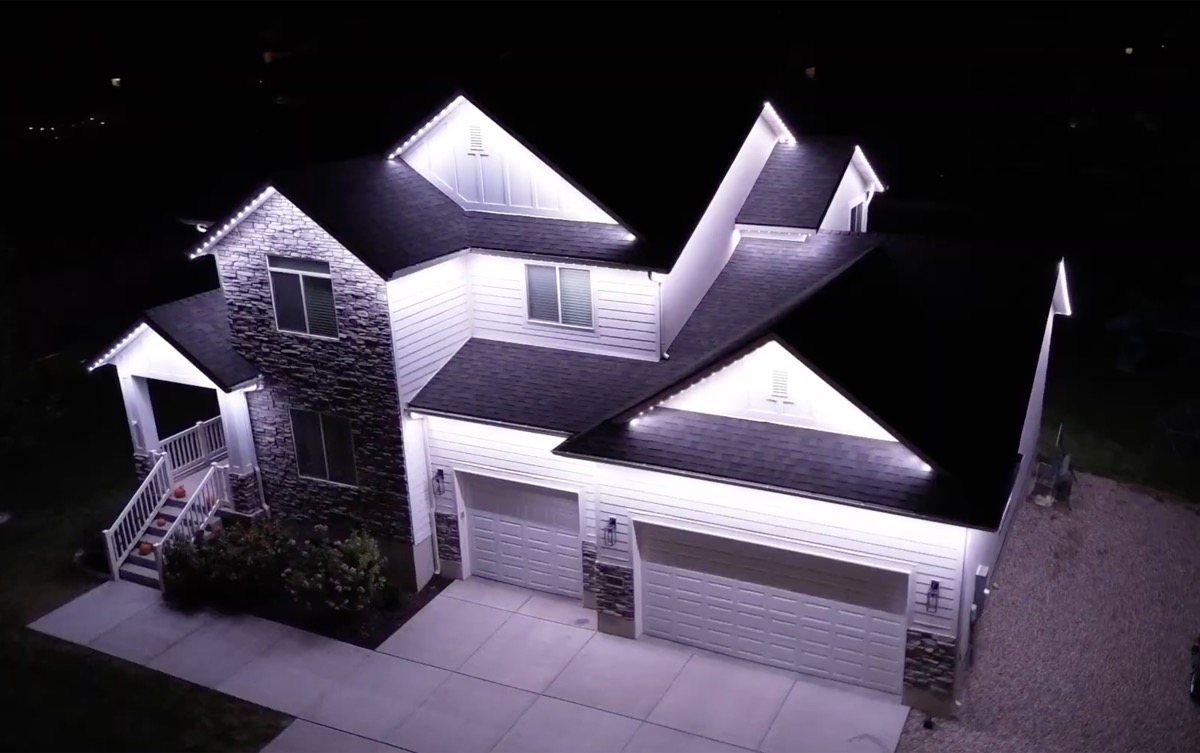
Voltage matters most on the kind of homes that line the Wasatch Front. If you've driven through the newer neighborhoods in South Jordan, Herriman, or up on the east benches of Sandy, you've seen them. Two stories. Three-car garages. Stone and stucco exteriors with complex rooflines wrapping around multiple peaks and dormers.
These homes easily have 200 feet or more of fascia to cover. On a 12-volt system, that means four separate power boxes mounted somewhere on the exterior. Each one needs its own electrical connection, its own wiring run, and its own set of penetrations through the soffit and fascia.
On TruLight's 48-volt system, that same home gets a single power supply. Fewer boxes. Fewer wires. A much cleaner result when you step back and look at it.
For homeowners in Cottonwood Heights and Holladay, where older custom homes have unique roof angles and mixed materials, the simplicity matters even more. Complex rooflines with lots of peaks and valleys are harder to wire with multiple power injection points. One power supply keeps the whole process straightforward.
Wondering what 48-volt lighting would look like on your Salt Lake City home?
Why Do Power Injection Points Add Cost to Your Installation?
Power injection points are spots along your roofline where additional power is fed into the system to keep it performing. A 12-volt system needs these roughly every 50 feet. TruLight's 48-volt system needs one every 300 feet. That gap directly affects what your project costs and how the installation holds up over time.
Each injection point means more hardware. More wiring. More holes drilled into your fascia and soffit. In Utah, every penetration is a spot where moisture can find its way in during spring snowmelt or a late-season storm. Fewer penetrations means fewer chances for problems down the road.
From a labor standpoint, more injection points means more time on the job. The installer has to route additional wire, mount additional hardware, and test each connection individually. On a large home, the difference between one injection point and four can add meaningful cost to the total project.
This detail never shows up on a product brochure. But it shows up on your quote.
True RGBW at 48 Volts: What Makes TruLight's LEDs Different
Running 48 volts is only part of the equation. What's packed into each light node matters just as much.
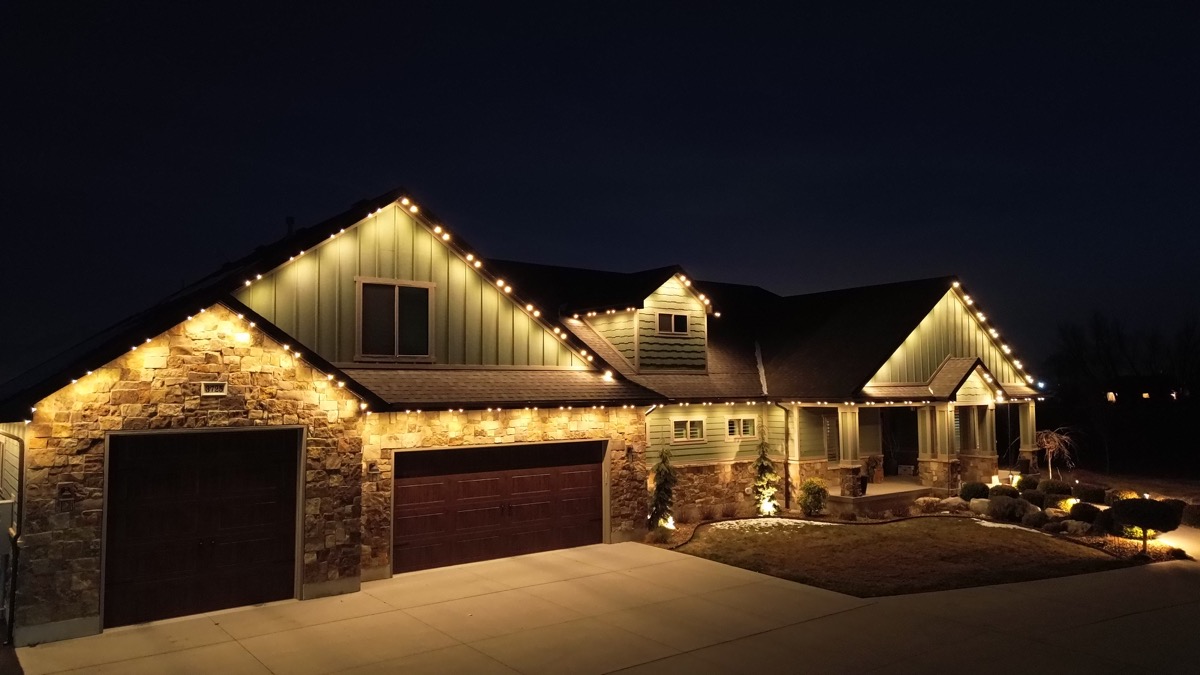
TruLight uses 6 LEDs per node: 3 RGB (red, green, blue) and 3 dedicated warm white. This is called true RGBW. When you turn on warm white, actual warm white LEDs are firing. Not a software guess. When all 6 fire together, you get pure white light that looks clean and natural, without the blue or purple tint that RGB-only systems produce.
Pure white matters because that is what most homeowners use on normal nights. In everyday use, most homeowners leave the system on warm white far more than holiday colors. Warm white for everyday accent lighting. Pure white for full brightness. If your system can't produce real white light, you're settling on the look you'll see every single night.
JellyFish runs 48 volts too. But their nodes have 3 RGB LEDs and are limited to 21 preset colors. TruLight's true RGBW offers millions of color combinations. You can dial in exactly the tone that complements your stone, stucco, or siding. And with animated patterns and music sync built into the system, the creative options go far beyond just picking a color.
Security Lighting That Covers Your Whole Home
One of the most practical benefits of a brighter 48-volt system is security. TruLight integrates motion sensors that trigger specific lighting scenes when movement is detected around your property.
At 90 to 120 lumens per node, the output is strong enough for usable roofline security lighting, not just decoration. When a motion sensor activates, your entire roofline switches to full bright white at once. Consistent brightness from corner to corner, because one power supply is driving the whole system evenly.
For homeowners in Sandy and Cottonwood Heights with larger lots, that uniform coverage makes a real difference at night. You get security lighting, accent lighting, and holiday lighting from one system. All controlled from your phone.
TruLight also uses a 4-wire design with a redundant data cable. If a single node ever fails, every other light on the system keeps running normally. On 3-wire systems (like Trimlight, Gemstone, and most other brands), every light past a failed node goes dark until the bad light is replaced. That reliability adds up when the system is supposed to work every night of the year.
Ready to see how TruLight's 48-volt system works on your home?
FAQ: Common Questions About 48-Volt Permanent Lighting
Is 48-volt permanent lighting safe for homes?
Absolutely. TruLight's 48-volt system is classified as low voltage, well below the 120 volts running through your standard outlets. The system plugs into a regular outlet through a power supply that converts household electricity down to 48 volts. If your home needs a new outlet or electrical work, that should be handled by a licensed electrician. It is still electrical equipment, but it is low voltage after the power supply.
How long do 48-volt permanent LED lights last?
TruLight's LEDs are rated at over 100,000 hours. Running 8 hours per day, that works out to 30 to 35 years of use. For comparison, Trimlight LEDs are rated at 50,000 hours (about 17 years), and JellyFish LEDs are rated at 50,000 hours with a controller lifespan of just 22,000 hours. TruLight's lifetime warranty covers the lights for 100,000 hours, which is 11.4 years from installation, and the control box for five years. See the warranty terms for details.
How does TruLight compare with other permanent outdoor lighting in Salt Lake City?
Based on manufacturer published specifications as of April 2026, TruLight is the only system in Salt Lake City that combines 48-volt architecture with true RGBW technology (6 LEDs per node), 4-wire redundancy, and a lifetime warranty. I have not seen another common Salt Lake City option with this exact mix of 48 volts, RGBW nodes, 4-wire redundancy, and a lifetime warranty. That combination delivers brightness at 90 to 120 lumens, coverage distance at 300 feet per power supply, and LED lifespan at over 100,000 hours. TruLight also includes animated patterns and music sync capability.
Can I control my permanent lights from my phone?
Yes. TruLight connects to a smartphone app that lets you pick colors, set schedules, build custom scenes, and trigger security modes from anywhere. Match your lights to holidays, change them with the seasons, sync them to music for a backyard party, or have them respond to motion sensors automatically. Zoning control lets you set different colors on different sections of your home at the same time.
Related Articles
The 48-volt difference isn't something you notice on a spec sheet in a showroom. You notice it the first time you look up and see one clean power supply instead of four. You notice it when your installation quote comes in lower than expected. And you really notice it the first night you switch on pure white and see your entire home lit up from the street. Give us a call at (801) 783-2039 or grab a free quote, and we'll show you exactly what 48 volts looks like on your home.
Ready to Light Up Your Home?
Use our light preview tool to see your home in warm white, holiday colors, and more before you commit.
Get Your Free Quote Instantly