
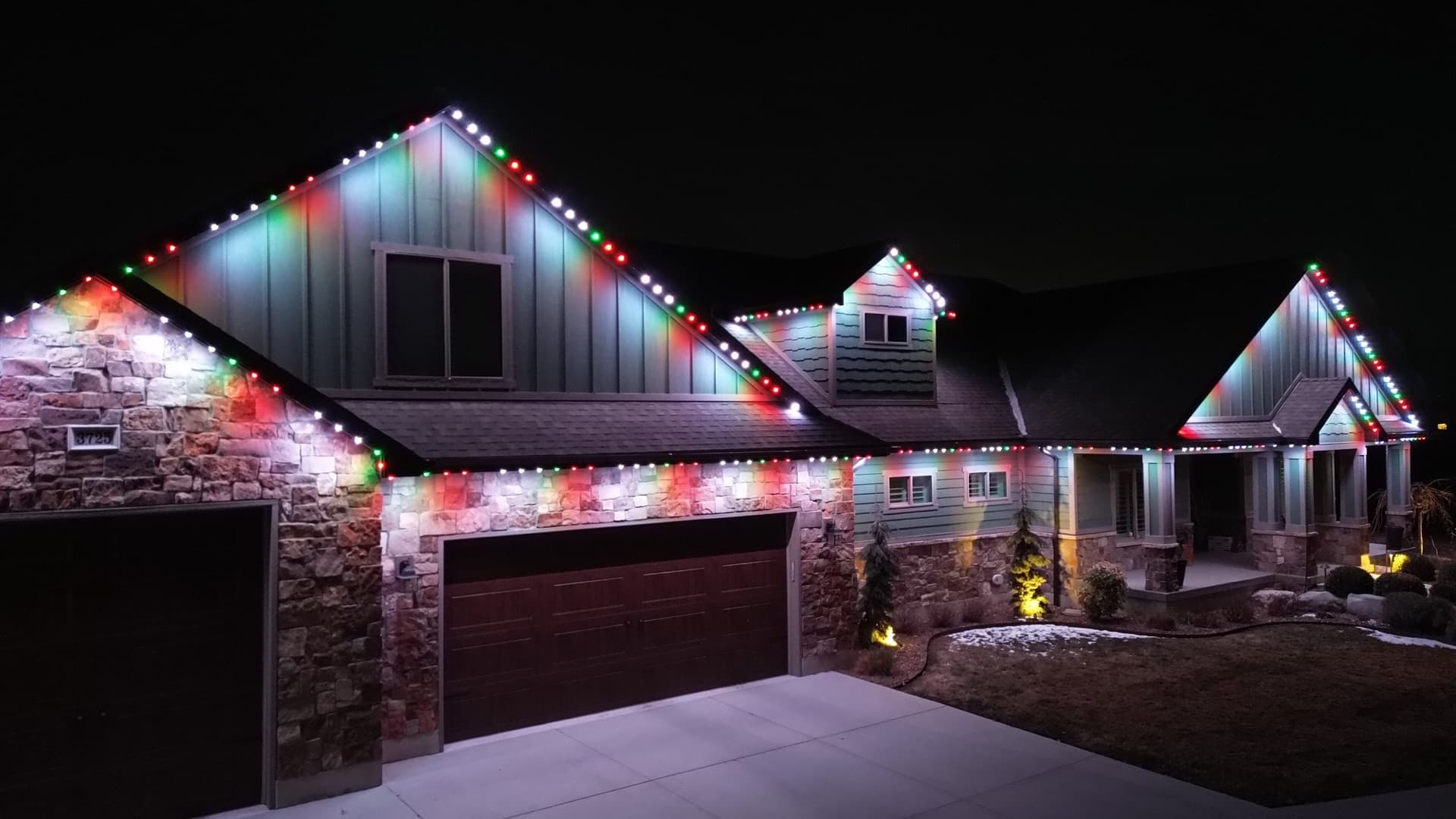
5-Year Cost Guide: Permanent vs Seasonal Holiday Lights in Salt Lake City
Every November, the same scene plays out across the Wasatch Front. It's 32 degrees, the sun set at 5:15, and somebody's up on a ladder trying to clip light strands to the gutters before Thanksgiving. Half the lights from last year don't work. The extension cord is six feet too short. And the whole project that was supposed to take an hour is now eating the entire Saturday.
We've installed permanent lighting on homes from Draper to Herriman, and the conversation almost always starts the same way: "I just want to know if it's actually cheaper in the long run." Fair question. So we sat down and built out the real numbers, year by year, for a typical Salt Lake City-area home. Not vague estimates. Actual costs you can check against your own receipts.
What Most SLC Homeowners Actually Spend on Seasonal Lights
People underestimate this number every single year. It's not just the lights. It's everything around them.
Here's what a typical Wasatch Front homeowner spends annually on seasonal holiday lighting:
- Light strings and replacement bulbs: $75-$150. Even if you reuse most of last year's strands, there's always a dead section or two that needs replacing.
- Clips, hooks, extension cords, timers: $30-$60. These get lost, broken, or left outside.
- Professional installation and removal: $400-$800, based on current Salt Lake-area seasonal lighting quotes. This is the big one. Demand in the SLC market spikes hard in November, and pricing reflects it. A two-story home in Cottonwood Heights or along the Sandy benches will be on the higher end.
- Electricity: $30-$75 per month if running incandescent strands. Even basic LED strings add $10-$20 monthly when you're running roofline, bushes, and yard features.
- Your time: Hard to put a dollar figure on, but most DIY setups eat 6-10 hours of a cold weekend. That's not nothing.
Add it all up, and the homeowner who does their own lights is spending $300-$500 per year. The homeowner who hires it out is spending $600-$1,100. And that's before anything breaks or gets damaged in storage.
The Year-by-Year Breakdown: 5 Seasons of Seasonal vs. Permanent
This is the comparison most websites skip over. They tell you permanent lights "pay for themselves" but never show you how the numbers actually stack up. So here's the math for a typical SLC home with about 150 linear feet of roofline.
Scenario A: Seasonal lights with professional installation
| Year | Install/Removal | Lights & Supplies | Energy (6 weeks) | Annual Total | Cumulative |
|---|---|---|---|---|---|
| 1 | $600 | $200 | $45 | $845 | $845 |
| 2 | $625 | $120 | $45 | $790 | $1,635 |
| 3 | $650 | $150 | $50 | $850 | $2,485 |
| 4 | $675 | $175 | $50 | $900 | $3,385 |
| 5 | $700 | $180 | $50 | $930 | $4,315 |
Scenario B: Permanent LED system (TruLight SLC)
| Year | Installation | Maintenance | Energy (year-round) | Annual Total | Cumulative |
|---|---|---|---|---|---|
| 1 | $3,800 | $0 | $52 | $3,852 | $3,852 |
| 2 | $0 | $0 | $52 | $52 | $3,904 |
| 3 | $0 | $0 | $52 | $52 | $3,956 |
| 4 | $0 | $0 | $52 | $52 | $4,008 |
| 5 | $0 | $0 | $52 | $52 | $4,060 |
The crossover happens right around year four. By year five, the permanent system is already $255 cheaper. And the gap keeps widening. Year six? Year seven? The seasonal homeowner keeps writing checks. The permanent system homeowner just pays for electricity.
That table doesn't even factor in your time. If your November weekends are worth anything to you, the permanent system pulls ahead even faster.
Want to see what the numbers look like for your specific roofline? We can run the math for your home on a free quote call, no strings attached.
Why Permanent Systems Cost What They Do
Sticker shock is real. When someone hears "$3,800" they naturally compare it to a $40 box of lights from the hardware store. But those are completely different products solving completely different problems.
Here's what actually goes into a permanent installation on a typical Wasatch Front home:
The hardware. TruLight SLC uses RGBW LEDs with 6 diodes per node: 3 RGB and 3 dedicated warm white. That dedicated white channel is the reason the warm white looks like actual warm light and not the bluish-purple tint you get from mixing RGB together. You're getting 2 to 3 times the brightness of standard permanent lighting systems, and each LED is rated for 100,000+ hours of operation.
The electrical architecture. The system runs on 48 volts. Most competitors use 12V or 24V systems. The higher voltage means less current draw for the same brightness, less heat buildup in the wiring, and more consistent output across long runs. For a home in SunCrest or along the Draper benches with 200+ feet of roofline, that consistency matters. A 12V system needs multiple power injection points on longer runs to keep brightness even, which adds hardware, labor, and cost to the install. A 48V system covers the same distance from a single power source.
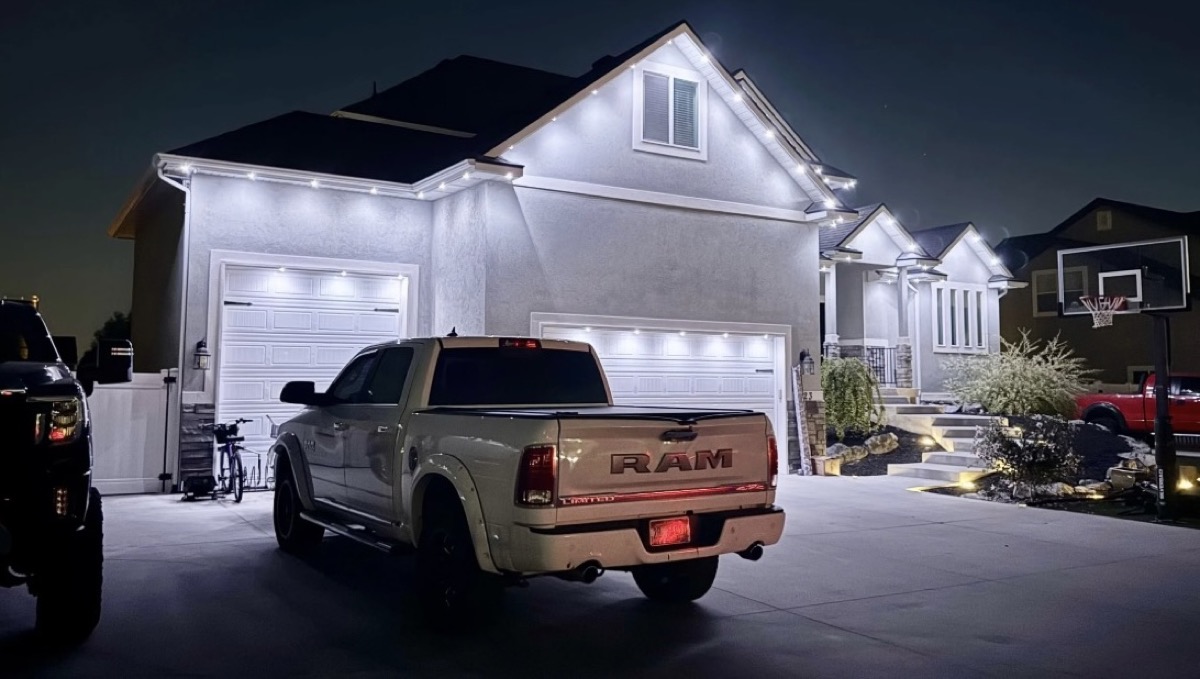
The installation. This isn't someone zip-tying LED strips to your gutter. Every foot of track is custom-measured and color-matched to your fascia. On Utah stone or stucco homes, the mounting has to be right or it looks wrong. The installation crew spends time getting the alignment clean so the track disappears during the day and only the light shows at night.
The warranty. TruLight carries a limited lifetime warranty on the lighting modules and control box: 100,000 hours, which is 11.4 years from installation. See the warranty terms for details. The point is simple: this is not a one-season product.
Wondering what it would cost for your home? Get an instant estimate using our satellite tool. No visit required.
Get Your Free QuoteThe Energy Math Nobody Talks About
Rocky Mountain Power residential rates were around $0.13 per kWh in 2025, based on Rocky Mountain Power's Utah residential rate schedule, and proposed or approved rate changes could push that higher. That makes the energy comparison between seasonal and permanent lighting more relevant than it was even two years ago.
Here's the quick math. A typical permanent LED system running 150 lights for 4 hours a night uses about 5-7 kWh per month. At current Utah rates, that's roughly $0.80 to $1.00 per month. Even if you run them 6 hours a night year-round, you're looking at maybe $4-$5 per month.
Now compare that to a seasonal incandescent setup. A standard C9 incandescent strand draws about 175 watts per 25-foot string. Four strings on a 100-foot roofline pulls 700 watts. Running those 6 hours a night for 6 weeks burns through about 176 kWh. At $0.13 per kWh, that's $23 just for the roofline. Add bushes, trees, and yard features and you're easily at $40-$60 for the season.
Using the assumptions above, the permanent system costs about $52 per year in electricity for year-round use. The seasonal incandescent setup costs $40-$75 for just six weeks. LED seasonal strings close the gap, but they still can't match the efficiency of a purpose-built 48V permanent system.
With Rocky Mountain Power's recent rate hikes, this difference only gets bigger each year. If rates climb again over the next few years, the permanent system's energy advantage grows.
18,000 ER Visits a Year (and Most Are From Ladders)
This is the part of the cost conversation that doesn't show up on any receipt.
The Consumer Product Safety Commission tracks holiday decorating injuries every year. The numbers are higher than most homeowners expect. About 18,400 people end up in emergency rooms annually because of Christmas decorating accidents. Of those, roughly 5,800 are from falls. And 65% of those falls happen on ladders.
One published study of severe Christmas-light installation injuries found patients were 95% male, with an average age of 55; fall-related morbidity was 28%, and mortality was 5%. Five percent of severe ladder falls while hanging Christmas lights were fatal.
That is the number that makes the ladder math feel different.
In Salt Lake City, the risk factors stack up. Two-story homes are common. Rooflines along the benches in Draper, Sandy, and Cottonwood Heights are steep. November temperatures sit in the 25-35 degree range, which means cold hands on cold metal rungs. Early darkness means people are rushing to finish before they lose light. And Utah's freeze-thaw cycles can make roof edges and gutters slippery in ways you don't notice until you're already up there.
A permanent system gets installed once by a professional crew with proper equipment. After that, you control everything from your phone. No more November ladder sessions. No more reaching over the gutter to clip one more strand.
That peace of mind doesn't fit neatly into a spreadsheet, but it's real. If you've been the one on the ladder every year, you already know what we're talking about.
What About Resale Value?
People who are thinking about selling in the next few years sometimes hesitate on permanent lighting. Makes sense on the surface. Why invest in a house you might leave?
In the Salt Lake market, buyers are starting to notice permanent lighting. It is becoming a feature that buyers notice and realtors highlight. In neighborhoods like Daybreak, SunCrest, and Traverse Mountain, where homes already have upgraded exteriors, permanent roofline lighting reads as a finished detail. It's in the same category as a well-designed landscape or a clean driveway. Buyers see it and think "this house is taken care of."
Exterior lighting can help curb appeal, but I would not treat it like a guaranteed resale bump. You may have seen figures as high as 12% tied to professional-grade landscape or architectural lighting, and if you lean on that number it is worth checking the source and remembering it refers to landscape or architectural lighting in general, not permanent roofline lights specifically. Even so, a clean, finished exterior tends to help when it comes time to sell.
The system also stays with the house, so the next owner inherits a working lighting system. That's a selling point you can put in the listing, and it's one that stands out in a market where most homes look the same at night.
If you're in one of the newer communities in Herriman or Eagle Mountain where homes are still appreciating, permanent lighting is the kind of detail that separates your home from the identical floor plan three doors down. That is the kind of detail buyers and visitors notice. It's one of the first things people comment on when they visit.
Beyond December: The Year-Round Math
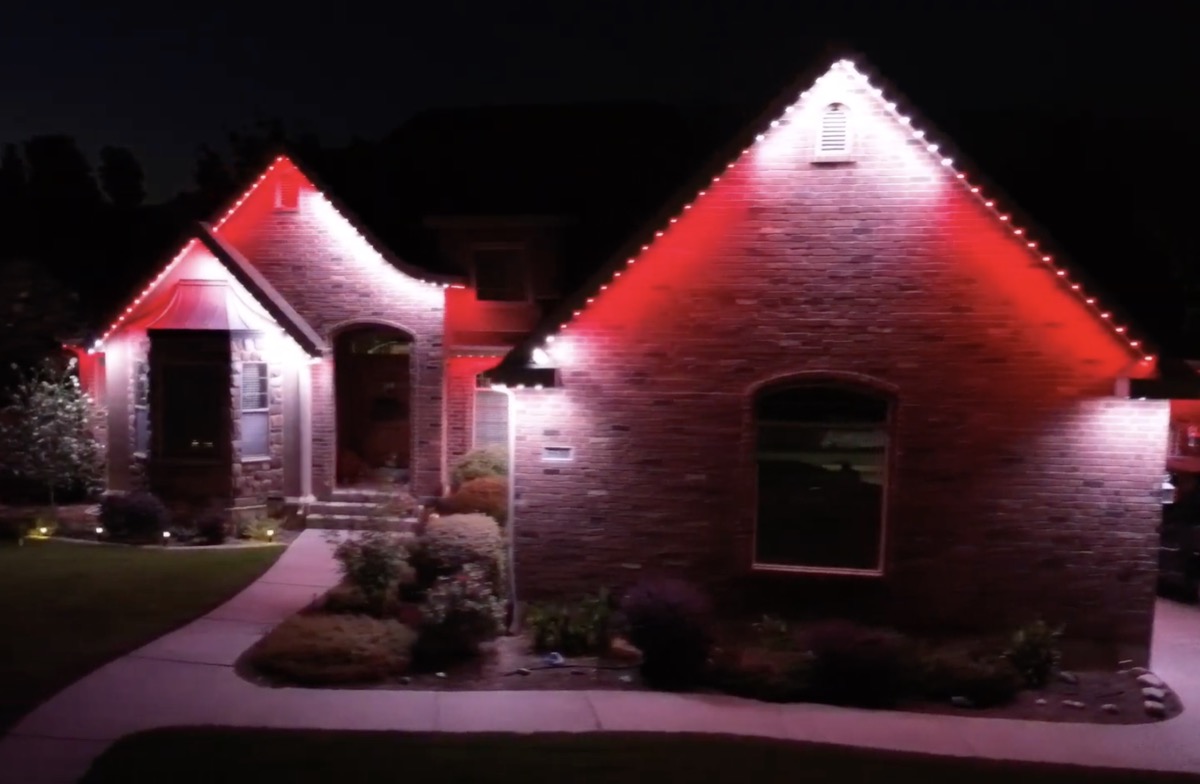
The 5-year cost comparison above only counts holiday use. But a permanent system works 365 days a year. That completely changes what you're actually paying for.
Most of our SLC homeowners use their lights far more than they expected. Here's what a typical year looks like:
- January through March: Soft warm white for dark winter evenings. The sun sets before 6 PM through February, and a lit roofline makes a real difference in how the house feels when you pull into the driveway.
- April and May: Accent lighting for spring evenings and backyard dinners.
- July: Red, white, and blue for the Fourth. Green and gold for Pioneer Day on the 24th. Utah is one of the only states that has two major holidays in July, so the lights get double duty.
- September and October: Orange and purple for Halloween. Soft amber for fall evenings.
- November and December: Full holiday mode. Classic warm white, multicolor, animated patterns, whatever you want. One tap on the app.
- Game days: Red for the Utes. Blue for BYU. Whatever colors your household roots for.
- Birthdays, graduations, parties: Pick any color, set it, done.
When you use the lights year-round, the cost per use gets very small. Seasonal lights give you six weeks. A permanent system gives you 365 nights.
That's the math that really matters.
Frequently Asked Questions
How much do permanent holiday lights cost in Salt Lake City?
For a typical Wasatch Front home with 120-180 linear feet of roofline, expect to invest between $3,000 and $5,500 for a professional permanent LED system. The exact price depends on your home's size, roofline complexity, the number of peaks and corners, and whether you want front-only or full-perimeter coverage. TruLight SLC offers free on-site quotes so you can get an exact number for your home.
Do permanent Christmas lights really save money over time?
Yes, if you're comparing against professional seasonal installation. A homeowner paying $700-$900 per year for install, removal, and light replacements will break even with a permanent system around year 4. After that, the permanent system costs only electricity to operate, roughly $50 per year. By year 7 or 8, the savings are well over $1,000 compared to continuing with seasonal service.
How much electricity do permanent LED lights use?
Very little. A 150-node RGBW system running 4-6 hours per night costs about $4 to $5 per month on Rocky Mountain Power's current rates. That's roughly $52 per year for year-round use. Compare that to seasonal incandescent strands that can cost $40-$75 for just the six-week holiday season.
Will permanent lights work on my Utah stone or stucco home?
Absolutely. The track is custom-cut and color-matched to your fascia, so it blends in during the day regardless of your exterior material. Utah stone, stucco, fiber cement, wood, and hardie board all work. The RGBW system's dedicated warm white channel looks especially good on the warm earth tones common on Wasatch Front homes, producing genuine warm light instead of the blue-tinted white that standard RGB systems create.
Related Articles
Look, we're biased. We install these systems for a living. But the math doesn't lie, and we showed you all of it. If you want to see what the numbers look like for your specific house, we do free quotes for homes anywhere along the Wasatch Front, from Eagle Mountain to Holladay. Grab a quote, compare it to what you spent last November, and go from there.
Ready to Light Up Your Home?
Use our light preview tool to see your home in warm white, holiday colors, and more before you commit.
Get Your Free Quote Instantly