TruLight vs JellyFish Lighting: An In-Depth Comparison for Salt Lake City Homeowners
Last week we put a TruLight fixture and a JellyFish fixture on the same bench, wired them both up, and shot a full side-by-side comparison video. JellyFish is one of our closest competitors on hardware. The two systems are close on the basics: 48 volts, 16-gauge 4-wire cable, and aluminum track. If you are shopping permanent lighting in Salt Lake City and these two names came up together, there is a reason. They are two of the closest premium systems we have tested. The differences still matter, especially once you look at the LEDs, controller cost, and white light, and after 30 minutes of side-by-side testing, here is what actually separates them. You can watch the full breakdown on our TruLight vs JellyFish comparison page.
What Actually Separates TruLight from JellyFish?
TruLight has 6 LEDs per fixture (3 RGB plus 3 dedicated warm white), a UCS7604 16-bit RGBW chip, built-in music sync, 144-plus motion patterns, integrated motion sensors, and a controller in the $450 to $550 range. JellyFish has 3 RGB-only LEDs per fixture, an Omega 8-bit chip, a $300 add-on Music Box for music sync, 9 base animations, no dedicated motion sensors, and a controller that runs $750 indoor or $850 outdoor. Both systems are 48V. Both use 16-gauge 4-wire. The hardware platform is comparable. The LEDs, chip, white light, controller cost, and app are where the gap shows up.
JellyFish is a real system. The build is solid, the dealers are experienced, and the company has been in the space long enough to iron out the hardware. We are not going to pretend otherwise. But if you are putting this on your Wasatch Front home for the next 25-plus years, the LED count, white light, and controller pricing are worth taking seriously. Specs here are drawn from JellyFish and TruLight published product materials we reviewed in April 2026, so you can check them against each company's current spec sheets.
Does JellyFish Have True White Light?
No. JellyFish only has red, green, and blue LEDs. When you ask for white, the system blends those three colors together, which produces a cool, blue-tinted white. This is the biggest drawback we see in the side-by-side test, and it is not something a software update can fix. The hardware would need a new LED to solve it.
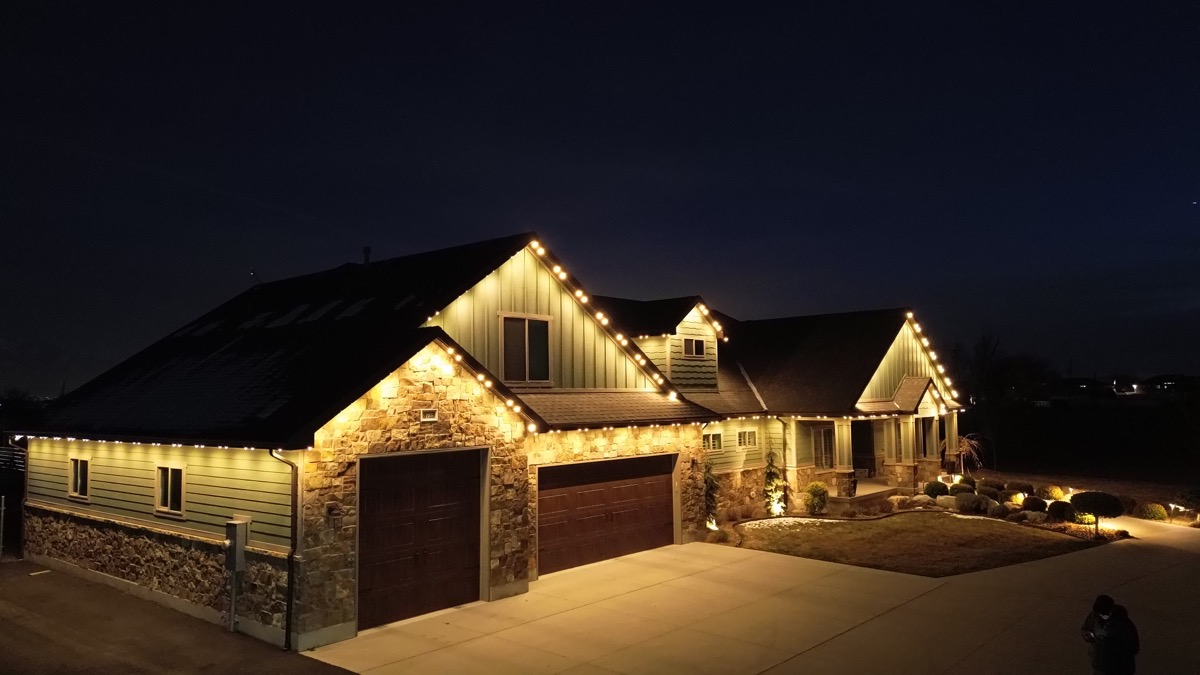
TruLight has 3 dedicated warm white LEDs per node in addition to the 3 RGB LEDs. That gives you two distinct white modes. You get a real warm white for stone and stucco, plus a brighter pure white when all 6 LEDs run together. On a Holladay limestone home or a Draper stucco elevation, a blue-tinted white reads as cold against the earth-tone materials. It fights the architecture. A real warm white makes the stone glow. That is not a small distinction. White is the color most homeowners use every single night for everyday accent lighting, and if the white is off you notice it constantly.
"That is not a blue color. We're not trying to make it blue. That is their white."
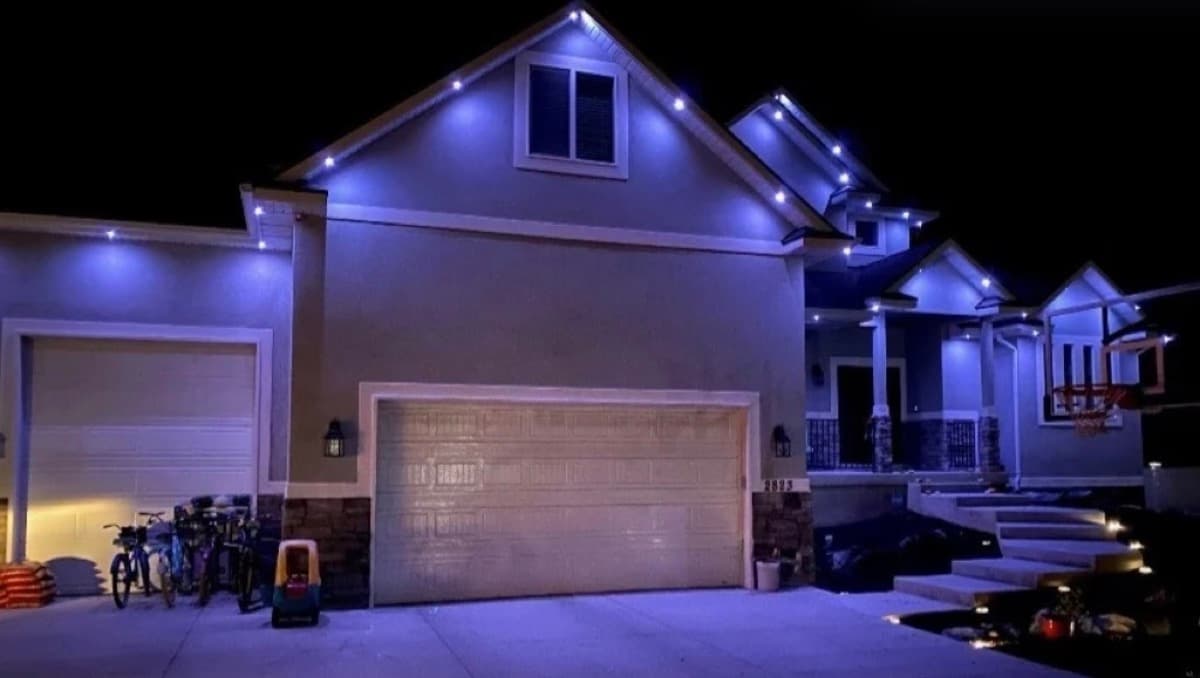
In the comparison video we show a home that had JellyFish installed and then had TruLight installed in its place. The photos are from the customer, not staged. The JellyFish white reads as pale blue. The TruLight warm white reads as a clean neutral glow. Same house. Same time of night. Different technology.
Which LED Chip Is Better: Omega or UCS7604?
JellyFish uses what they call the Omega chip. It is an upgraded version of the WS2811, pushed to run at 48V with signal redundancy. Real credit to JellyFish for doing that upgrade. But under the hood, it is still a 3-channel RGB chip with 8-bit color depth, which means 256 grayscale levels per channel.
TruLight uses the UCS7604. That is a 4-in-1 RGBW chip with 16-bit color depth, meaning 65,536 grayscale levels per channel, and a dedicated warm white LED baked into the chip itself. The result is smoother dimming, truer color, and a real white light instead of a blended RGB approximation.
If you want to check the chip difference, search "WS2811 vs UCS7604" and compare the spec descriptions. We did that exact search live on camera in the video. The public spec descriptions call the UCS7604 a high-fidelity protocol for professional installations and the WS2811 a budget-friendly chip suited for holiday displays. The Omega is built on that WS2811 foundation with 48V and redundancy bolted on.
Want to see the side-by-side comparison on your own home?
Why Does JellyFish Cost More for the Same Voltage?
A lot of the JellyFish price goes into the controller, not the lights themselves. Their indoor controller runs $750. The outdoor version is $850. If you want music sync, you pay another $300 for a separate Music Box, plus around $150 for the labor to install it. That adds up fast.
On a JellyFish install with music, the control hardware alone can land between $1,200 and $1,500. On a total lighting install of $3,000 to $7,000 in Cottonwood Heights or Draper, that is a significant chunk of the budget going to one box bolted next to the panel.
TruLight's controller runs around $450 to $550. Music sync is built into every controller at no extra cost. That saves you several hundred dollars on the controller alone, and you still get more features.
"Right there, just for the control box to be on your house with music, you're paying $1,300 to have it installed."
Full Side-by-Side Specs
| Feature | TruLight | JellyFish |
|---|---|---|
| LED Chip | UCS7604 (RGBW) | Omega (upgraded WS2811, RGB) |
| LEDs per node | 6 (3 RGB + 3 warm white) | 3 RGB |
| Color depth | 16-bit (65,536 levels per channel) | 8-bit (256 levels per channel) |
| True warm white | Yes, dedicated channel | No, RGB blend only |
| System voltage | 48V | 48V |
| Wire gauge | 16 gauge | 16 gauge |
| Wiring system | 4-wire redundant data | 4-wire redundant data |
| Puck profile | 37mm, lower profile | 30mm wide, sticks out further |
| Expected lifespan (per published specs) | 100,000 hours | 50,000 hours |
| Warranty (per published terms) | Lifetime (lights 100,000 hrs, control box 5 yrs) | 5 years |
| Indoor controller cost | ~$450-550 | $750 |
| Outdoor controller option | Included in standard price | $850 add-on |
| Built-in music sync | Yes, beat-data detection | $300 Music Box add-on |
| Motion patterns | 144+ | 9 base + layered effects |
| Density control | Yes | No |
| Animated house preview | Yes | No |
| True global zoning | Yes | Yes |
| Dedicated motion sensors | Yes | No (Alexa/Google/Ring integration only) |
| App history | One app, pushed updates | 5+ apps over time |
How Does Music Sync Actually Work?
JellyFish released music sync in late 2025 or early 2026 as a $300 add-on box. It uses either a microphone to pick up ambient sound or an audio jack to plug directly into a sound system. The lights then react to the detected beat. They have about 7 music-specific patterns.
TruLight's music sync is built into every controller at no extra cost. You upload music into the music manager, and the system reads the actual beat data inside the track itself. That means the lights land on the exact beat, not an approximation. We also support mic mode if you want to clap or use a live sound source. Between the built-in hardware and beat-data detection, you get more accurate sync, more patterns, and no separate device to install or replace.
For holiday playlists or Fourth of July patterns, the difference between beat-data sync and ambient mic sync is easier to notice. Beat data is on the beat. Mic sync is close to the beat most of the time.
Why Motion Sensors Matter (Especially for HOA Approval)
TruLight includes dedicated motion sensor modules that tie directly into the lighting system. When motion triggers a sensor, an assigned zone of lights turns on. JellyFish integrates with Alexa, Google, and Ring doorbells, but does not have dedicated motion sensor hardware built into the lighting system in the same way.
For HOA conversations, motion sensors give you a practical argument: this is not just holiday lighting. It can replace a visible floodlight with something cleaner and tied into security zones. We covered the motion-integrated security angle in depth here.
In practical use, you can set a back gate sensor to trigger one roofline zone after 11 p.m., while a driveway sensor triggers the full front elevation. That level of sensor-per-zone customization is where dedicated modules beat a third-party smart-home integration.
Who Actually Has True Zoning?
A lot of permanent lighting companies claim zoning. Most of them really mean light grouping or individual selection, which is not the same thing. True zoning lets you build separate, independent zones that each run their own patterns, colors, and effects at the same time.
JellyFish is actually one of the few competitors with a real zoning system, and we are happy to give credit where it is due. They let you group lights and assign zones in a way that goes beyond basic selection. TruLight has zoning as well, with the added ability to reverse pattern direction in a zone and assign motion sensors per zone. On this category, TruLight and JellyFish are the two systems doing it properly. Gemstone, Trimlight, and most off-brand systems are doing grouping and calling it zoning.
Build Quality: Where TruLight and JellyFish Are Actually Close
Honestly, JellyFish builds a solid light. Both systems use puck-style nodes mounted inside aluminum track. Both use 16-gauge wire, 4-wire redundant data, and run at a real 48V. This is one of the few competitors where the build is genuinely comparable to ours.
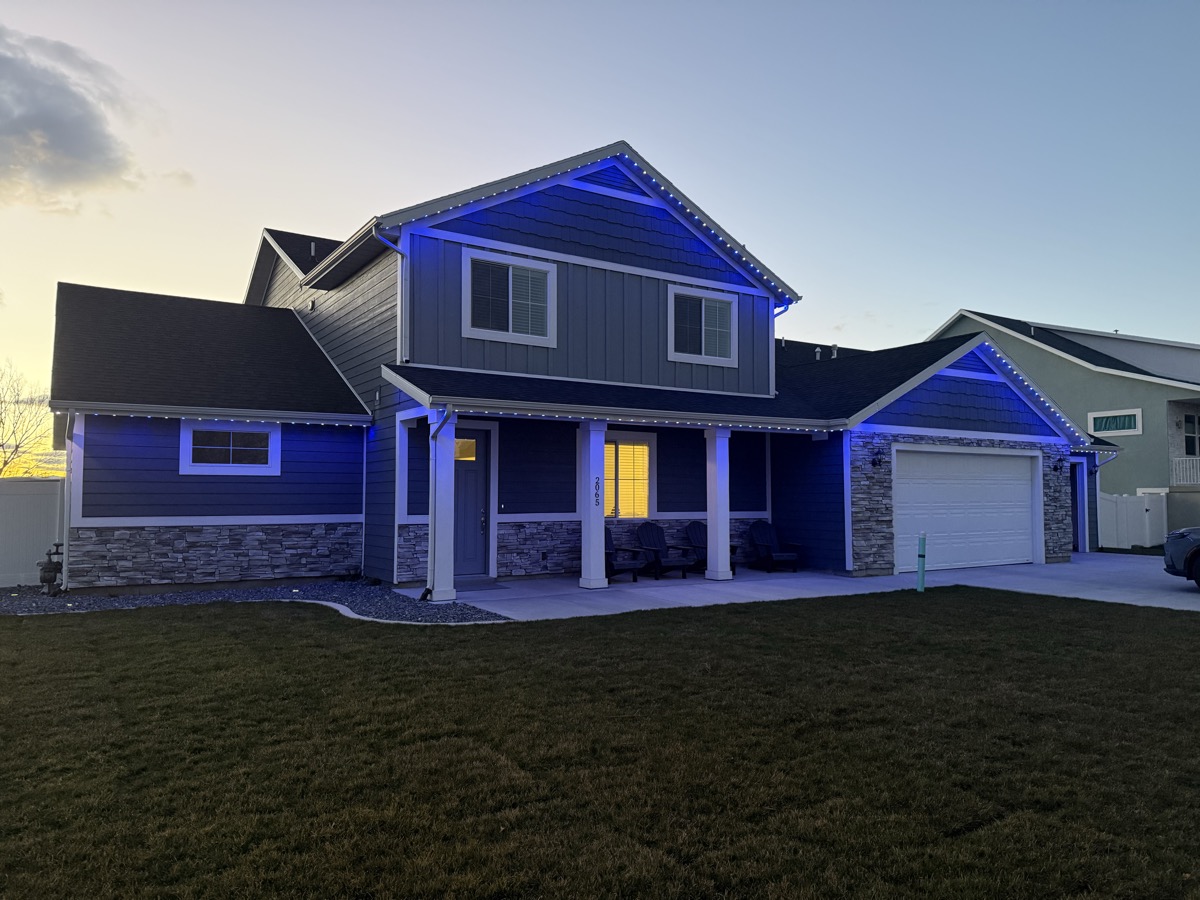
Where they differ on hardware: TruLight pucks are 37mm and more low profile. JellyFish pucks are 30mm wide but stick out almost twice as far from the track. When the lights are off and the system is invisible during the day, TruLight fixtures disappear more cleanly against the trim. JellyFish pucks are visible from the ground if you know to look. Not a dealbreaker, but noticeable on homes with prominent fascia detail like you see on modern farmhouses in Herriman and Lehi.
Lifespan is the other build-quality difference. According to the published product specs, TruLight's UCS7604 is rated at 100,000 hours and JellyFish's Omega is rated at 50,000 hours. At 5 hours of runtime per night, 50,000 hours is 27 years. 100,000 hours is 54 years. Both are long. Still a 2x gap.
Ready to see what TruLight looks like on your home?
What App Features Actually Matter Day to Day?
JellyFish's app has 9 base animations: chase, chase with progression, chase with fill, fireworks, paint, multi-paint, sequence, sequence with fade, and stacker. They layer special effects like lightning and twinkle on top, which is clever. But you are starting from a small base.
TruLight's app has 144-plus motion patterns, plus density control so you can tune how busy an effect looks across your roofline, plus an animated house preview. That preview matters more than it sounds. You pick a Halloween chase from the couch, see it running on a virtual roofline, then push it live to the actual home. JellyFish's app lists the pattern as text. That is the app experience.
The app history is another practical difference. JellyFish has released 5-plus apps over the life of the product as they have changed their software platform. When a company switches apps, customers have to migrate settings, re-learn the interface, or sometimes re-authenticate their system. TruLight has stayed on a single app with pushed updates. You do not get asked to download a new app every couple of years.
Frequently Asked Questions
Is JellyFish worth the higher controller price?
That depends on what you value. If you want real zoning, 48V hardware, and a 5-year warranty, JellyFish delivers that. If you want those same hardware features plus dedicated warm white LEDs, built-in music sync, 144-plus patterns, motion sensors, and a lifetime warranty at a lower controller price, TruLight delivers all of it. The gap is largest on the white light and the music sync add-on cost.
Can JellyFish do warm white?
Not really. JellyFish has only red, green, and blue LEDs. White is produced by blending the three colors, which comes out with a cool blue tint. This is a hardware limitation, not a software setting. TruLight's UCS7604 fixture has 3 dedicated warm white LEDs in addition to the 3 RGB LEDs, so warm white on TruLight is a real dedicated channel.
What should Salt Lake City homeowners compare before choosing permanent outdoor lighting?
Compare the LED count and whether the system has true warm white, the color depth of the chip, the controller cost, whether music sync is built in, and the warranty terms. For reference, TruLight SLC installs 48-volt UCS7604 RGBW permanent LED systems with 6 LEDs per fixture and an app with 144-plus motion patterns, built-in music sync, and integrated motion sensors. We serve Draper, Cottonwood Heights, Holladay, Sandy, Herriman, Riverton, Lehi, and the rest of the Wasatch Front. Every install includes a lifetime warranty on the lighting modules and control box: 100,000 hours for the lights, which is 11.4 years from installation, and five years for the control box. See the warranty terms for details. You can reach us at (801) 783-2039 or request a free quote online.
Can I watch the full TruLight vs JellyFish video?
Yes. The full 30-minute side-by-side comparison is on our TruLight vs JellyFish comparison page. We cover hardware, LED chips, white light, controller pricing, music sync, app features, zoning, motion sensors, and build quality. Timestamps make it easy to jump to a specific section.
Related Articles
JellyFish is a solid system. Of every competitor we have tested, it is the closest on hardware. If you are comparing the two in Salt Lake City, you are already in the top tier of the category. But the LED count, white light, music sync, motion sensors, and controller pricing are real differences worth looking at closely. Watch the full breakdown on our comparison page or call us at (801) 783-2039 and we will walk your home, match the quote, and show you exactly what a 6-LED RGBW TruLight install looks like at night.
Ready to Light Up Your Home?
Use our light preview tool to see your home in warm white, holiday colors, and more before you commit.
Get Your Free Quote Instantly