Video Comparison
TruLight vs Generic / DIY Lights: The Full Breakdown
Cheap permanent lights from Amazon, Temu, and generic dealers usually run on a free white-label app called SurpLife. The light hardware can look almost the same as ours. But the app is where the real value lives, and that is where the gap is huge.
Jump to a Section
Here's the Bottom Line
You can buy a permanent light off Amazon for $80 a roll. The light itself might even look identical to ours. But when you plug it into the SurpLife app, you are getting a free, generic platform that was never built specifically for permanent outdoor lighting. Fewer patterns. No house preview. No real zoning. No motion sensors. No way to grow the system over time. The app is the real product, and the app is where TruLight is years ahead.
Custom App vs White-Label
SurpLife is a free, generic app that powers everything from cabinet lights to permanent outdoor lights. TruLight built our own app from scratch, over $500K invested, so every feature is built for permanent lighting on a house.
144+ Patterns vs 5
TruLight has 144+ motion patterns with density control and an animated house preview. SurpLife has about 5 effects you can confirm but not preview on a roofline. You are guessing what it will look like.
True Zoning Unlocks Everything
SurpLife can group or select lights, but it cannot run independent zones. That means no per-area music, no landscape integration, no motion sensors. With TruLight, your system grows with you.
Full Side-by-Side Specs
| Feature | TruLight | Generic / SurpLife |
|---|---|---|
| App | Custom-built TruLight app | SurpLife (white-label, generic) |
| App Development Investment | $500K+ | Free third-party platform |
| Motion Patterns / Effects | 144+ | About 5 |
| Density Control | ||
| Animated House Preview | ||
| True Zoning | ||
| Multi-Port Output | Up to 4 lines of data | Single port |
| Reverse Pattern Direction by Zone | ||
| Motion Sensor Integration | ||
| Per-Zone Music Sync | ||
| Music Effects | About 20 | About 3 |
| LED Chip | UCS7604 (RGBW, 16-bit) | Typically WS2811 / generic (RGB, 8-bit) |
| True Warm White | ||
| System Voltage | 48V | Varies (5V, 12V, 24V, or 48V) |
| Warranty | Limited lifetime | Varies, often none or limited |
| Expected Lifespan | 100,000 hours | Varies, often under 50,000 hours |
| Update Cadence | Pushed updates from a single team | Generic third-party platform, no roadmap influence |
*App Development Investment: SurpLife is a generic platform that runs on cabinet lights, light strips, bulbs, and more. The features are not specific to permanent outdoor lighting.
*Animated House Preview: SurpLife shows effects on a generic Christmas-tree preview. TruLight previews each effect on an animated roofline so you see what it actually looks like on a house.
*True Zoning: SurpLife supports light grouping and selection but cannot run independent zones. Zoning is what unlocks motion sensors, landscape add-ons, and per-area music.
*Per-Zone Music Sync: SurpLife can play music on the whole system. TruLight lets you choose which zones the music plays in, like backyard only.
Limited Lifetime Warranty. Full warranty details
The Familiar Three-Lens Puck Is a Form Factor, Not a Whole System
We photographed a purchased Bosso three-lens node beside a TruLight diffused node at the same camera height. The Bosso sample is on the left. The TruLight node is on the right. This is a physical form-factor comparison, not evidence that every three-lens product uses identical internals.
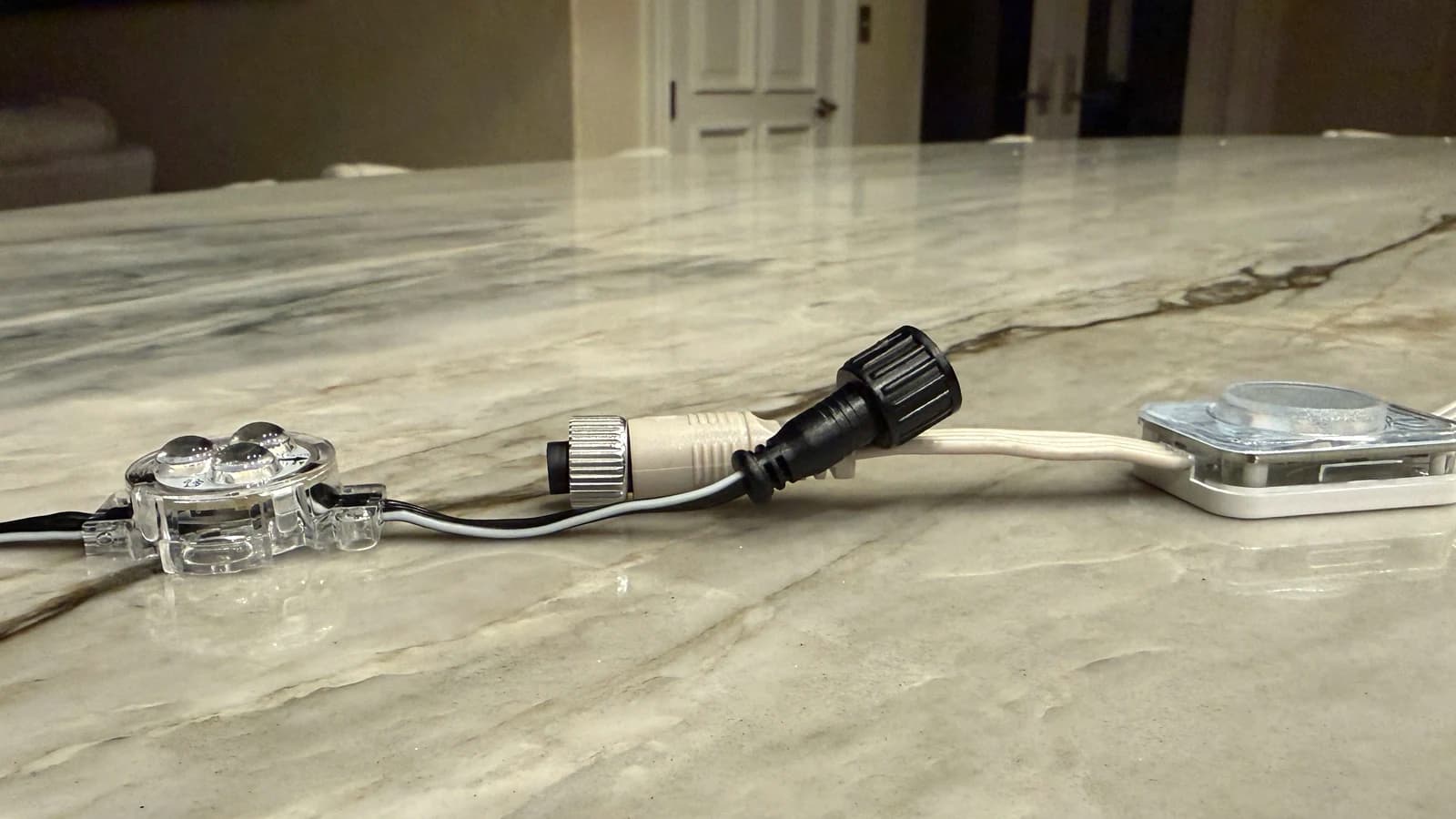
Current supplier listings advertise 12V, 30 mm RGBW point lights with three LEDs for permanent track installations. That means a familiar puck shape can be sourced separately from the controller, app, track, warranty, installation, and long-term support that determine how the full system performs.
See a current 12V three-LED permanent track light supplier listingWhat's Actually Inside a Generic Permanent Light System?
If you crack open a budget permanent light kit from Amazon or Temu, you usually find three pieces. A power supply. A controller box with a Bluetooth or Wi-Fi chip. A signal amplifier. The lights connect with a 3-wire system, and the controller talks to your phone over Bluetooth.
The chip inside the LED is almost always a WS2811 or a generic clone. WS2811 is a 3-channel RGB chip with 8-bit color depth, which means 256 grayscale levels per channel. TruLight uses a UCS7604 instead. That is a 4-in-1 RGBW chip with a dedicated warm white LED and 16-bit color depth, or 65,536 grayscale levels per channel. Smoother dimming, truer color, and a real white light instead of a blended RGB approximation.
Don't take our word for it. Google “WS2811 vs UCS7604” yourself and read what comes up. Google describes the UCS7604 as a high-fidelity protocol for professional installations, and the WS2811 as a budget-friendly chip ideal for holiday displays.
See the hardware breakdown at 7:22 in the videoWhy Is the App More Important Than the Light?
Think about computers. A $350 laptop and a $2,500 laptop both have a screen, a keyboard, and a trackpad. The hardware looks similar. But one is a basic browser machine and the other is a high-end workstation. The difference lives in the technology inside, not the case.
Permanent lighting works the same way. The light is not the expensive part of the system. The app is. We have invested over half a million dollars into building the TruLight app from the ground up, just for permanent outdoor lighting. That investment is what gives you 144+ patterns, real zoning, motion sensor integration, an animated house preview, and per-zone music control. None of that comes from the light itself.
Putting a premium light behind a free, generic app is like putting race-car tires on a minivan. You paid for hardware that the software cannot use.
See the computer analogy at 3:17 in the videoWhat Is SurpLife and Why Does It Matter?
SurpLife is a third-party LED app used by hundreds of unrelated products. Cabinet lights. Bulb strips. Garage lights. Generic permanent lights. It is what the industry calls a white-label app, which means anyone can pay SurpLife to skin it with their own logo and brand. So you might download an app that looks branded for a small lighting company, open it up, and find out it is just SurpLife with a new color scheme.
That is not a bad thing for a $30 cabinet light. It works fine. But when the same generic platform is running a $3,000 permanent lighting install, the limits show up fast. The features inside SurpLife have to work for cabinet lights and strip lights and bulbs all at the same time, so they stay generic. There is no roadmap for permanent-outdoor-lighting features like real zoning, animated house previews, or motion sensors.
If you are buying generic lights and the dealer hands you a SurpLife app, you are paying for permanent-lighting hardware to run on a cabinet-light platform.
See the SurpLife walkthrough at 5:51 in the videoWhat's the Difference Between 5 Patterns and 144?
SurpLife ships with around 5 motion patterns for permanent lights. You tap one and hit confirm. There is no preview that shows what it will look like on your roofline. The closest thing is an icon on a Christmas-tree graphic, which is not very helpful when you are picking lights for a house.
TruLight has 144+ motion patterns built in. Every pattern shows up on an animated house preview before you turn the lights on, so you can see how dense the effect is, how fast it moves, and how it flows around the corners. We also include density control, which lets you tune how busy any pattern looks. One on, two off. Two on, three off. You decide.
TruLight App
- 144+ motion patterns
- Density control
- Animated house preview
- True zoning
- Motion sensor zones
- Per-zone music sync
- Single app, pushed updates
SurpLife
- About 5 motion effects
- Density control
- Animated house preview
- True zoning
- Motion sensor zones
- Per-zone music sync
- Generic platform, shared with cabinet lights
Why Single-Port Systems Limit Your Install
Generic SurpLife systems use a single port. One line of data comes out of the controller, and every light has to chain off that one line. On a real house with multiple roof sections, that means you have to jump up to the next eave, then loop the line back. The flow of the lights ends up zig-zagging instead of running cleanly across the front.
TruLight controllers run up to 4 separate lines of data. That gives the installer real flexibility on how the chases and animations move across your home. We can start two ports in opposite corners and have them meet in the middle, or run the front separately from the back, or reverse the direction on a specific leg so the pattern flows the way you want.
Multiple ports also matter on the install side. Lower current per leg, fewer power injection points needed, and a cleaner run of track below the fascia or soffit.
See the multi-port breakdown at 10:47 in the videoWhat Is Zoning and Why Does It Unlock Everything Else?
Zoning is the single most important feature most homeowners have never heard of. Real zoning means you can split your lighting system into independent groups that each run their own colors, patterns, and effects at the same time. SurpLife cannot do real zoning. It can group lights or let you select individual ones, but you cannot run the front of the house in a Christmas chase while the gazebo runs warm white at the same time.
That gap matters because zoning is the foundation. If you cannot zone, you cannot have motion sensors that trigger only one section. You cannot tie in landscape lights and control them separately. You cannot light up just the dog run when the dogs go out. You cannot keep the front yard quiet while the backyard plays music.
With TruLight, every install gets real zoning out of the box. Front yard, back yard, gazebo, garage, dog run, RV pad. Each one can run its own scene, its own schedule, and its own motion sensor.
See the zoning breakdown at 17:42 in the videoHow Does Per-Zone Music Sync Actually Work?
SurpLife supports music sync, but only on the whole system at once. If you turn on music mode, every light on your house starts dancing. That is fine for one quick demo, but it gets old fast, and your neighbors are not going to love it either.
TruLight ties music sync directly to your zones. Pick the backyard. Pick the gazebo. Pick both. The music plays only on the zones you choose, while the rest of the house stays in whatever scene you set. You are grilling out back and you want the lights to dance with the playlist? Done. The front yard stays clean and quiet while you do it.
We also have around 20 music-specific effects, compared to about 3 in SurpLife. Different beat detection styles, different visual reactions, and an actual music manager that reads the beat data inside each track for accurate sync.
See the music sync walkthrough at 24:06 in the videoWill This System Still Work for You in Two Years?
Most homeowners start out wanting holiday lights. Then a year later, they want to light the backyard for grilling. Then they want a motion sensor by the side gate. Then they want the gazebo on its own zone. Each of those upgrades is easy on a TruLight system, because the technology was built for it from day one.
On a SurpLife system, those upgrades are usually a wall. The app cannot zone. The controller cannot drive motion sensors. There is no roadmap for new features specific to permanent outdoor lighting. The dealer who sold it to you is also limited because they do not own the app and cannot push updates.
We have personally pulled hundreds of generic systems off houses where the homeowner thought they were saving money up front. The replacement cost ends up far higher than just buying right the first time. Buy once, cry once.
See the future-proofing argument at 27:44 in the videoStraight From the Video
“Who cares what the lights can do if the app does not actually have the features you are looking for?”
“The light is not the expensive part of the system.”
“Why would I put a high-performance tire on a vehicle that is not capable of using it?”
Ready to See the Difference?
Get your instant quote, then use our free preview tool to draw your roofline and see what TruLight looks like on your home. The same hardware investment, but on an app that actually grows with you.